
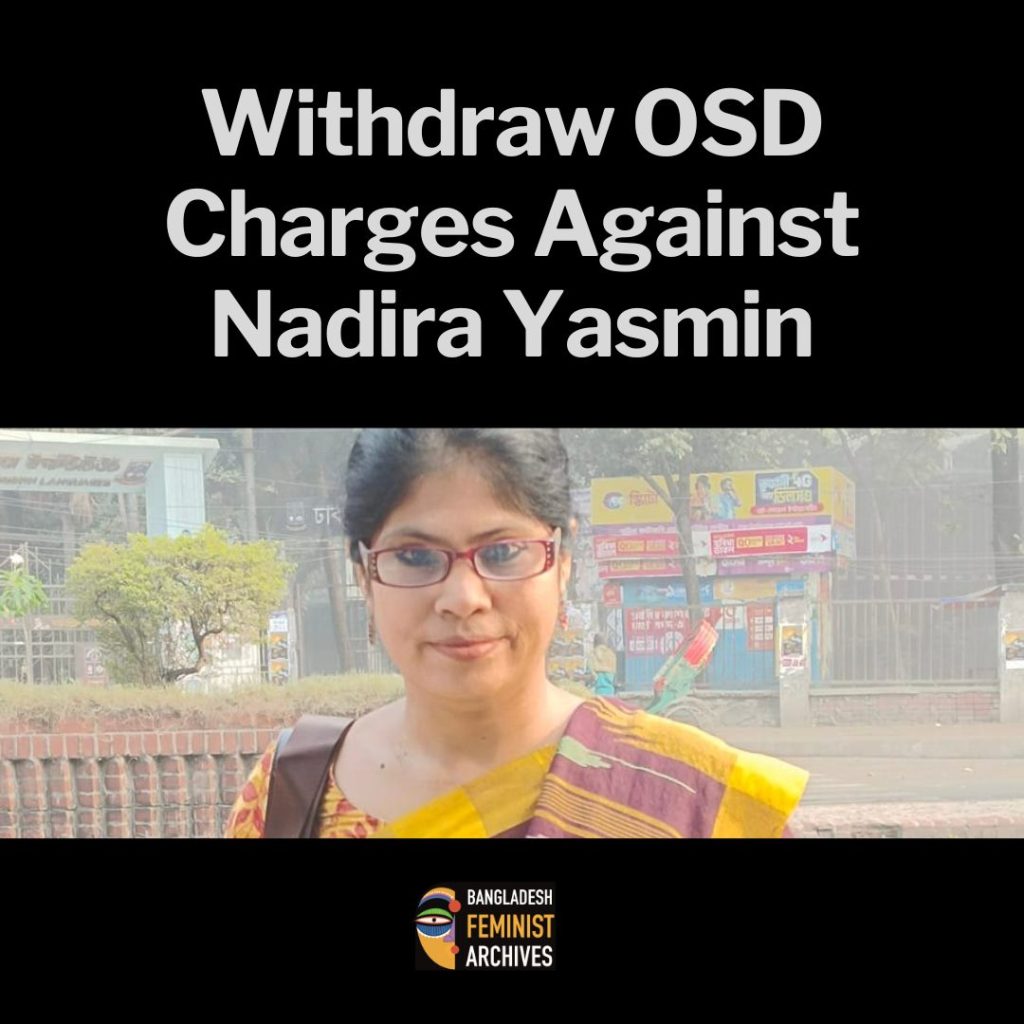
Nadira Yasmin, formerly Assistant Professor at Narsingdi Government College, was transferred to Satkhira Government College under OSD (Officers on Special Duty) orders issued by the Secondary and Higher Education Division of the Ministry of Education. This decision came shortly after Hefazat-e-Islam submitted a memorandum to the District Administrator on May 25, 2025, demanding her removal within 48 hours. Accusing her of being anti-Islam, anti-Quran, and Islamophobic, Hefazat had been agitating for her dismissal. For a long time, Nadira has faced both physical and online intimidation for her advocacy of equal property rights between men and women, a stance she elaborates in her published book, Hissa (Rights).
Freedom of speech is guaranteed by the Constitution of Bangladesh and is a cornerstone of any democracy. Nadira Yasmin committed no crime. She simply voiced an opinion in a public debate. Even if her position were controversial, she had every right to express it. The state’s duty was to protect her, not surrender to mob pressure. Instead, her transfer under public intimidation reflects a dangerous precedent: that no opinion outside the mob’s mandate is safe. This is not just injustice, it is state-enabled coercion, and a troubling signal from the Interim Government of Bangladesh that freedom of expression is negotiable.
It must also be emphasized that the position for which Nadira has been targeted, equal inheritance rights for women, is aligned with recommendations made by the Women’s Rights Reform Commission. Her forced transfer in the face of mob pressure raises serious concerns about the government’s actual commitment to gender equality.
We call on the Interim Government of Bangladesh to immediately withdraw the OSD charges against Nadira Yasmin, reinstate her to her previous post, and affirm its commitment to protect freedom of expression and women’s rights. Failing to do so would send a chilling message not only to educators and activists but to everyone who believes in democracy, the values of the July Uprising, and the principles of free speech, conscience, and equality that it stood for.
 Bangladesh Feminist Archives