
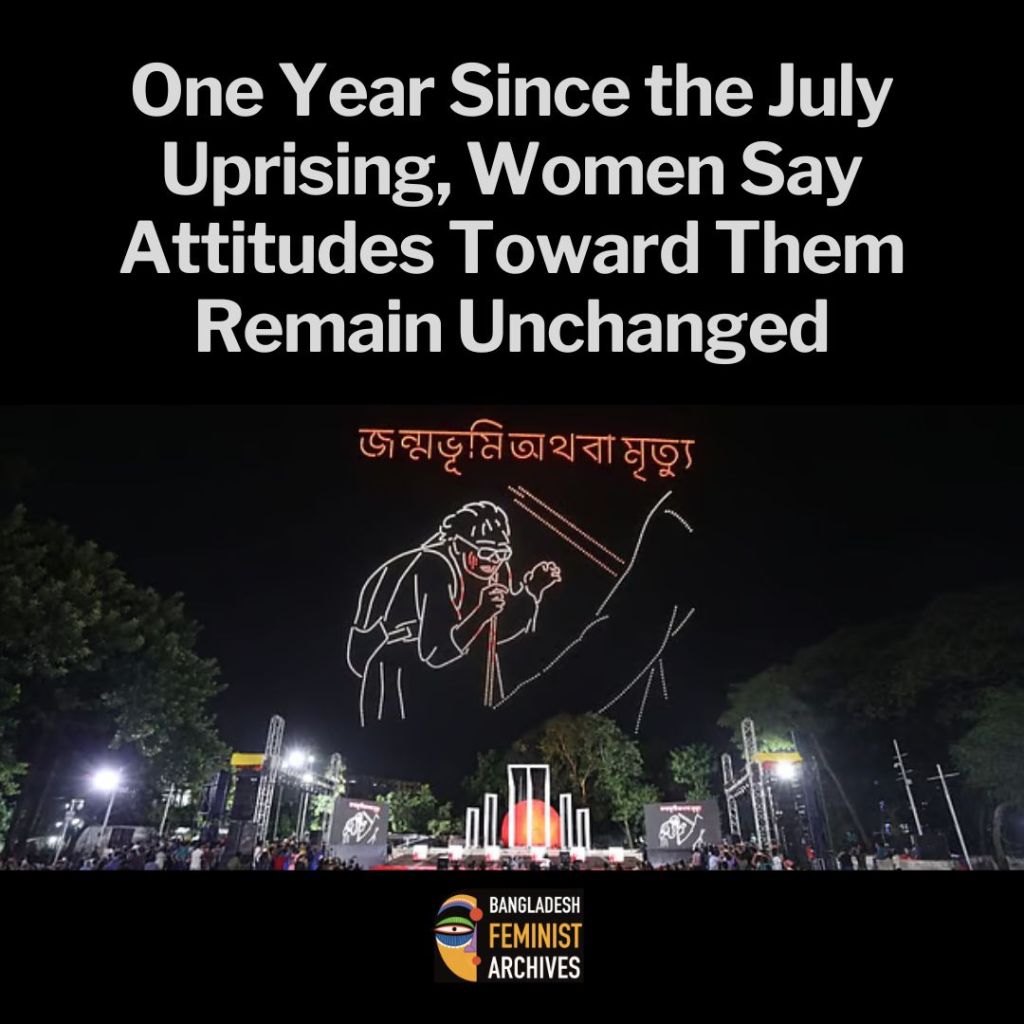
On July 15, hundreds gathered at the Central Shaheed Minar to mark July Women’s Day, a commemoration of women’s role in the July 2024 Uprising. Organized by the Ministry of Cultural Affairs and supported by Shilpakala Academy and Dhaka University, the event brought protest songs, documentaries, and direct testimony from women who helped lead the movement.
But many of those women say little has changed.
“Women are still only brought to marches or camera frames, not decision-making tables,” said Nusrat Tabassum of the Anti-Discrimination Movement. “Our voices are still symbolic, not valued.”
Speakers described facing humiliation, erasure, and online abuse. Sohagi Samia, who was injured in the protests, declared, “The women who stood before bullets cannot be silenced by mockery.” From North South University, Nafsin Mehnaz urged, “We will not retreat. This new Bangladesh is ours to build.”
A drone show lit up the sky with slogans from 2024:
“Tumi ke, ami ke, razakar, razakar”
“Dofa ek, dabi ek, Sheikh Hasinar podotyag.”
Short films were screened on the protest casualties and martyrs like Mahbub Alam and Abrar Fahad. In a deeply emotional moment, Abrar’s brother, Abrar Faiyaz, spoke of earlier attempts to silence the story: “This documentary was stopped before by threats. Not this time.”
Women from outside Dhaka also took the stage. “We were beaten and arrested. But now, no one remembers us,” said Anisha from Madaripur.
As the night closed with revolutionary music and a final drone display documenting 16 years of state repression, a reminder echoed from the stage:
“This July is not just Dhaka’s. It belongs to every woman who rose up.”
News Source: Prothom Alo
 Bangladesh Feminist Archives