
by Tasmim Jahan Neeha
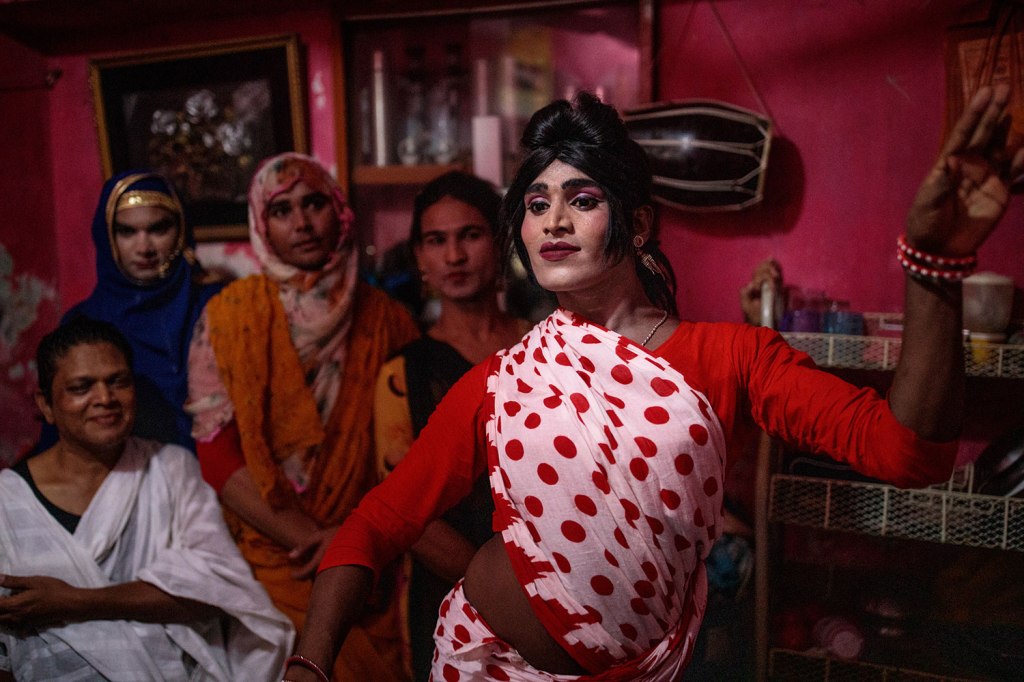
While stuck in Dhaka traffic, you may notice a group of people—perhaps in shiny makeup, colourful clothes, or with a flower tucked into their buns. They might be asking motorists for money or bargaining with roadside vendors. For many, this is the common image of hijras in Bangladesh. Too often, they are caricatured as cosplayers in women’s clothing, or dismissed as harassers and extortionists. For a large section of society, the very word hijra carries derogatory connotations—associated with shame rather than dignity.
The Path to Recognition
The hijra community in Bangladesh has long lived under systemic exclusion, structural inequality, and entrenched poverty. On January 26, 2014, the Government of Bangladesh announced official recognition of hijras as a “third gender,” with a single line in its gazette: “The Government of Bangladesh has recognized the Hijra community of Bangladesh as a third gender.”
This was celebrated as a watershed moment. A government manual followed, aiming to provide a basic understanding of hijras and promising affirmative actions. Yet, more than a decade later, there has been no official review of whether those promises were fulfilled.
Some tangible changes did occur. In 2014, the Department of Immigration and Passports added an “other” option in gender markers. In 2019, the Election Commission allowed hijras to register as “third gender” voters. Most recently, the 2022 Population & Housing Census officially recorded 12,629 persons under this category—the first national headcount to do so.
Does Visibility Reduce or Reinforce Vulnerability?
Recognition alone has not protected hijras from violence. In fact, their increased visibility has often made them more vulnerable to harassment, stigma, and state neglect.
One glaring example occurred in December 2014, when 12 hijras were recruited under a government employment scheme. As part of the hiring process, they were subjected to medical examinations. Physicians humiliated them, labeling them “disgusting,” and instructed janitors and security guards to physically examine their bodies, including touching their genitals.
This was not an isolated incident, but rather a striking case of institutional violence that persists despite official recognition.
The Enforcement Gap: Recognition Without Rights
The 2014 incident constitutes cruel, inhuman, and degrading treatment, prohibited under Article 7 of the International Covenant on Civil and Political Rights (ICCPR)—to which Bangladesh is a party. Under the Bangladesh Constitution, Article 27 guarantees equality before the law, and Article 31 protects life and personal liberty. Both were violated.
The UN Human Rights Committee’s General Comment No. 18 makes clear that discrimination on the basis of gender identity violates the principle of non-discrimination. The Yogyakarta Principles—though not binding—interpret existing treaty obligations, requiring states to ensure equal access to healthcare (Principle 17) and protect against medical abuse (Principle 18).
Domestically, while the 2013 National Human Rights Commission Act allows the NHRC to investigate such violations, the absence of a comprehensive anti-discrimination law leaves remedies discretionary. This undermines Bangladesh’s Article 2(1) ICCPR obligation to ensure rights without discrimination and provide effective remedies.
Comparative jurisprudence strengthens this claim: the European Court of Human Rights in Goodwin v. UK and the Inter-American Court of Human Rights in Advisory Opinion OC-24/17 both affirm that gender identity is central to human dignity and must be legally protected.
Beyond Quotas: Towards Dignity and Inclusion
Legal protection alone cannot guarantee dignity without social transformation. Hijras cannot be reduced to tokens filling quotas or symbolic gestures of diversity. They must be integrated into society as competent, independent, and dignified individuals.
Only then can we hope that hijras in Bangladesh will live lives marked not by humiliation, but by respect and equality.
References
- International Covenant on Civil and Political Rights (ICCPR), Articles 2(1), 7.
- Constitution of the People’s Republic of Bangladesh, Articles 27, 31.
- UN Human Rights Committee, General Comment No. 18: Non-Discrimination (1989).
- Yogyakarta Principles on the Application of International Human Rights Law in Relation to Sexual Orientation and Gender Identity (2007).
- National Human Rights Commission Act, 2013 (Bangladesh).
- European Court of Human Rights, Christine Goodwin v. United Kingdom (2002).
- Inter-American Court of Human Rights, Advisory Opinion OC-24/17 (2017).
 Bangladesh Feminist Archives