
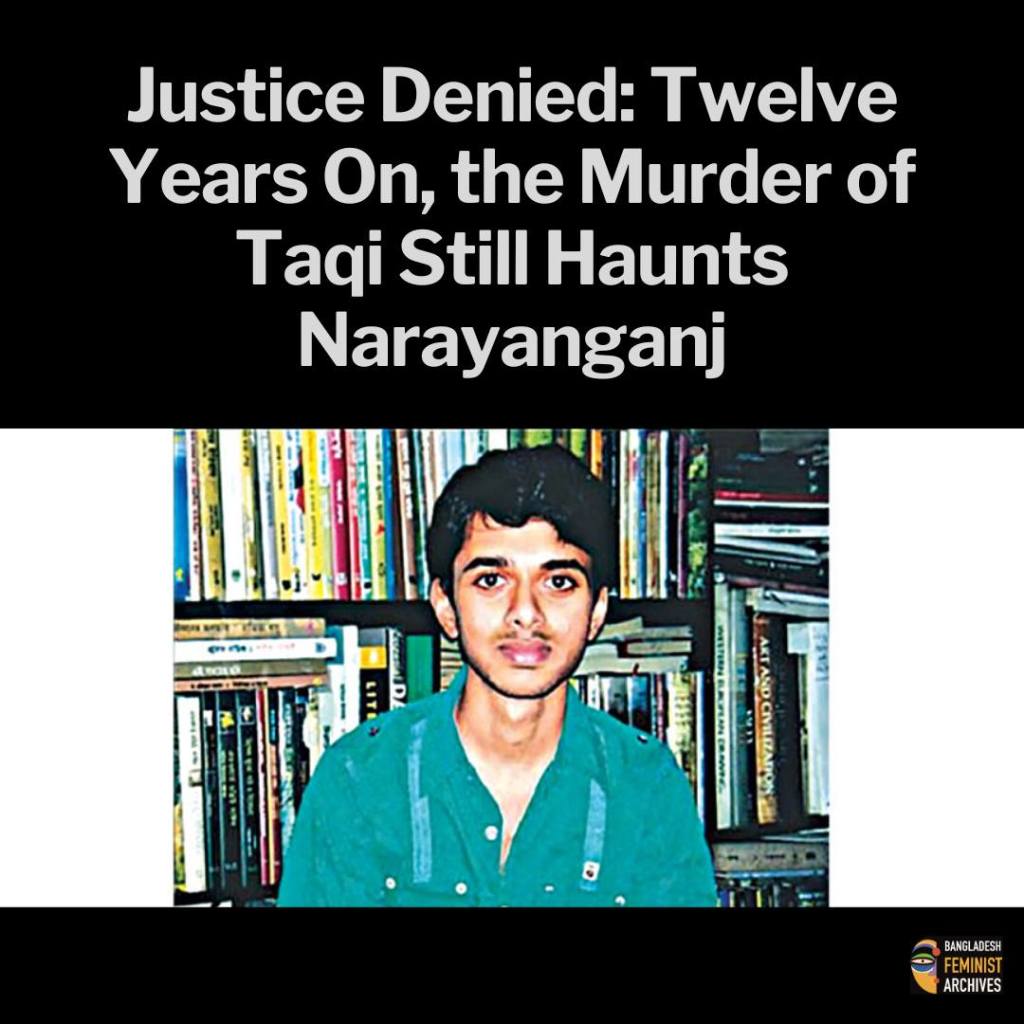
On the night of March 6, 2013, 17-year-old Tanvir Muhammad Taqi, a brilliant student from Narayanganj, was abducted near his home and later found dead in the Shitalakhya River, his body bearing marks of brutal torture. His murder sparked outrage across Bangladesh, igniting student protests, candlelight vigils, and a citizens’ movement demanding justice. Yet, more than a decade later, justice remains painfully elusive.
According to case documents and a recent confessional statement by accused Kajol Hawladar, Taqi was tortured and murdered inside the Winner Fashion office on Allama Iqbal Road, allegedly in the presence of Azmeri Osman, a member of the influential Osman family, and others. His body was later dumped into the river. Despite public protests, media coverage, and repeated promises, the case has been buried under political protection and procedural delays.
In the early investigation, RAB-11 had identified several suspects, and a leaked draft report named powerful individuals linked to the murder. But that draft never reached court as an official charge sheet. Families and activists accuse the state of deliberate obstruction, while the Criminal Investigation Department has failed to advance the case for trial.
Taqi’s father, Rafiur Rabbi, a well-known cultural activist, has spent twelve years filing petitions and organizing protests demanding justice. Every March 6, the Taqi Smriti Sangsad renews the call for accountability, met only by silence. “The killers walk free, protected by power,” Rabbi said, echoing the despair of countless families whose children’s deaths remain unpunished.
What began as one teenager’s murder has come to symbolize Bangladesh’s deep-rooted culture of impunity. Even with confessional evidence and eyewitness accounts, no indictment has ever been made. For Narayanganj, it remains an open wound; for Bangladesh, a haunting reminder of how justice bends before power.
Today, Taqi would have turned 30, but his age remains frozen at 17. His story stands among Bangladesh’s many unsolved political murders: a life silenced, a father’s unending fight, and a nation’s collective failure to protect its children.
 Bangladesh Feminist Archives