
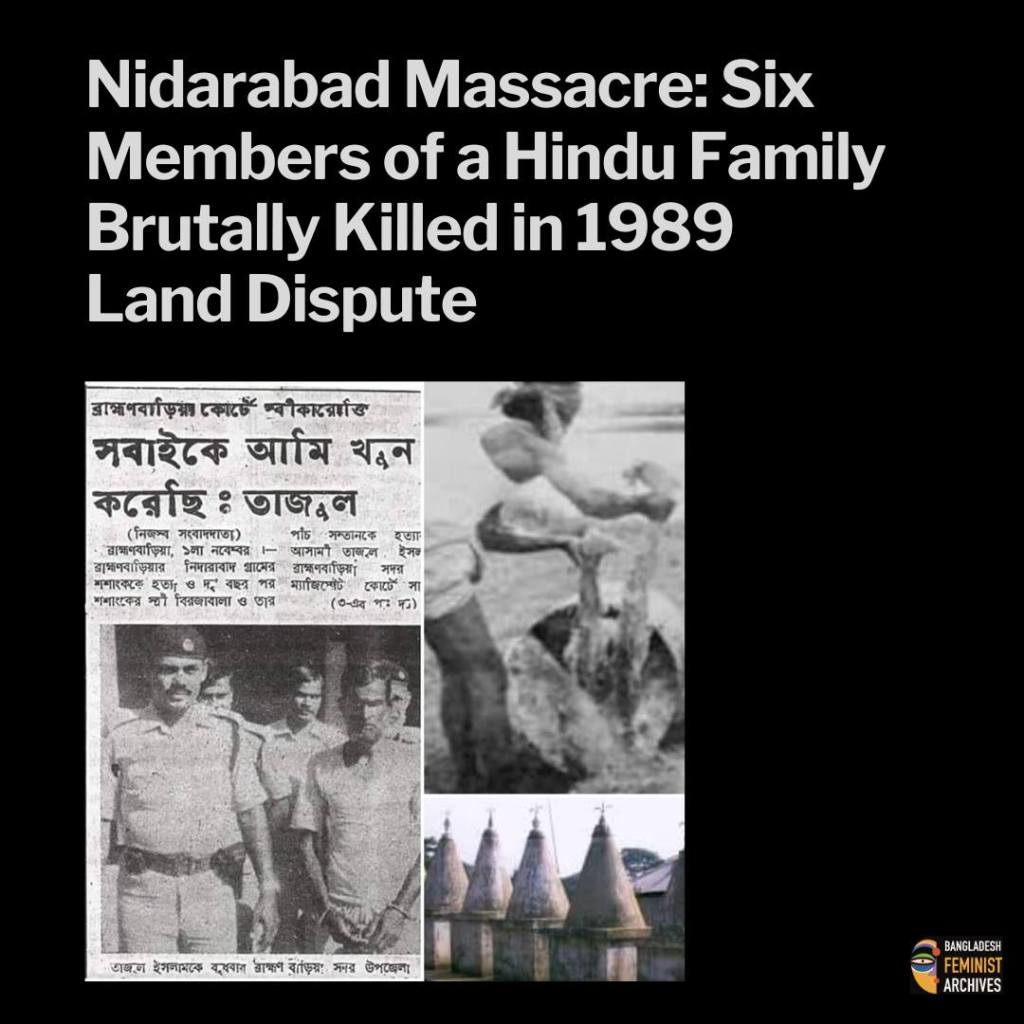
On the night of 6 September 1989, a horrific massacre took place in Nidarabad village of Nasirnagar upazila, Brahmanbaria, when a Hindu woman and her five children were murdered by a local mob. The victims, Birajabala Debnath and her children, aged between a few months and mid-teens, were dragged from their home and killed by a group of 15–20 men led by local land grabbers attempting to seize the family’s ancestral property.
Witnesses and investigators later revealed that the attackers tied up the family, took them to the bank of Dhopajhuri Beel, and killed them one by one. Their bodies were then dismembered, stuffed into metal oil barrels with salt and lime, and dumped in the water. The gruesome discovery came eight days later, on 14 September 1989, when one of the barrels floated to the surface and struck a passing boat, exposing the remains.
The killings sent shockwaves through the region, becoming one of the most brutal examples of communal and land-grabbing violence in post-independence Bangladesh. Despite widespread condemnation, justice for the victims moved painfully slowly. For decades, the case lingered with little progress until 2012, when Idris Patwari, one of the prime accused, was finally arrested after 23 years in hiding. He was later sentenced, but many others involved in the killings remain free.
The Nidarabad Massacre stands as a chilling reminder of the intersection between communal hatred, gendered violence, and state neglect. Birajabala’s death, along with her children’s, symbolizes both the vulnerability of minority families in rural Bangladesh and the long impunity surrounding land-related persecution of marginalized communities.
 Bangladesh Feminist Archives