
by Tanveer Anoy
It’s bizarre, it’s weird, it’s inappropriate, but am I surprised? Umm, no.
After the July Revolution, you have been trying so hard to fix your image. For years, you were Hasina’s obedient army of order, doing whatever she said, no questions asked. When she fled, you didn’t know what to do with yourselves, so you bowed to the next ruler like clockwork. Now, under the so-called “interim” government of Yunus Shaheb and his circus cabinet, you have turned your Facebook page into a PR rehab center. Suddenly, you are posting “updates” on ongoing cases, pretending to be the voice of reason in a country drowning in mob violence and chaos. Except, you sound exactly like what you have always been: a moral police in uniform, not a protector of justice.
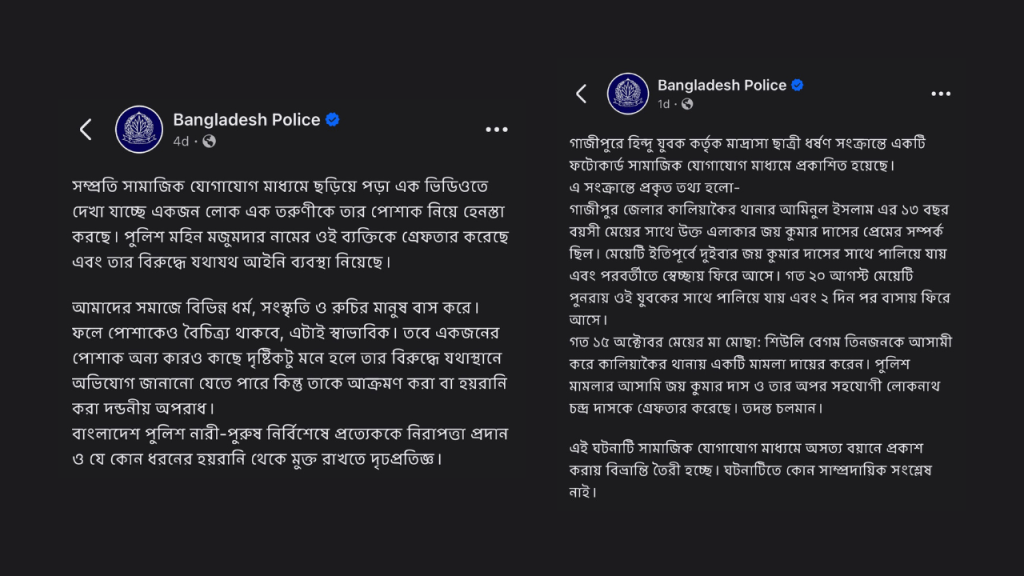
Take your latest masterpiece. You wrote about a 13-year-old madrasa student raped by a man, and somehow called it a “love relationship.” Love relationship? She’s a child. She’s thirteen. That’s statutory rape. But of course, your report makes it sound like she was an equal participant, she “ran away voluntarily,” she “came back home.” That’s not neutral language; that’s the state’s favorite way of gaslighting survivors and blaming children for the violence done to them. You turn trauma into romance so that no one has to be held accountable.
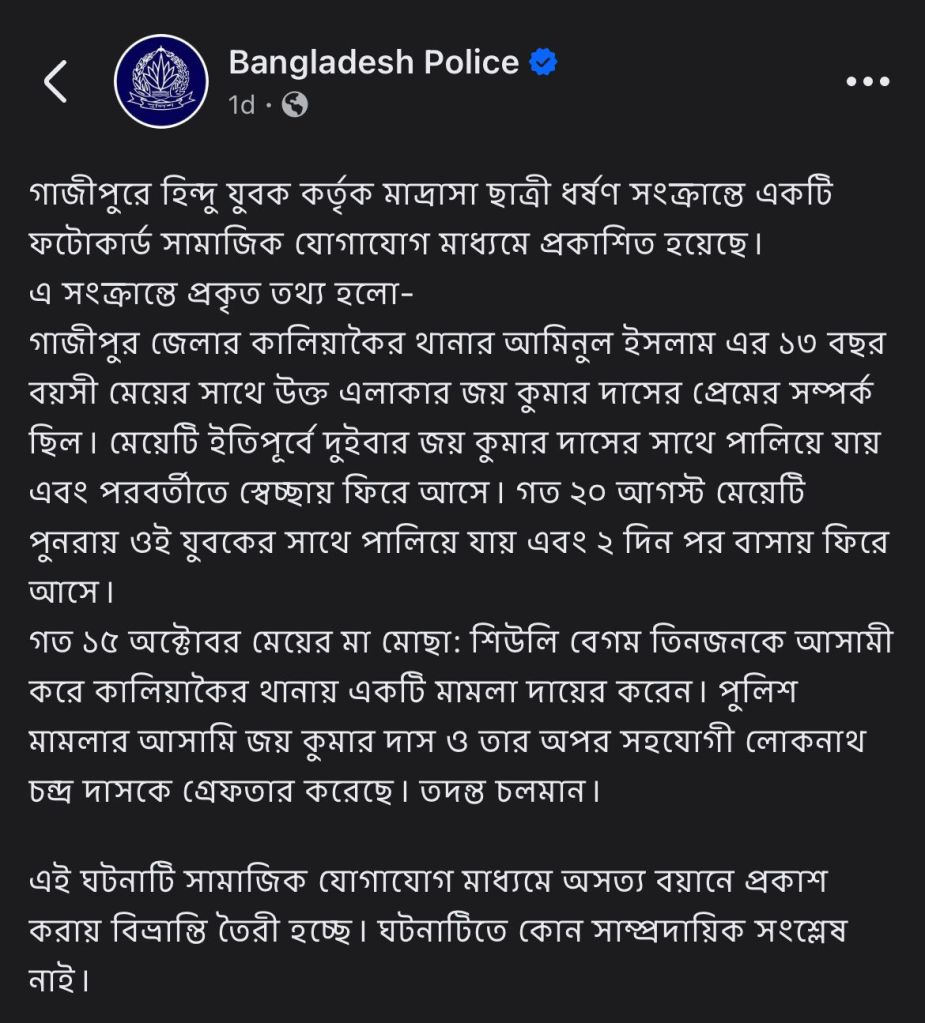
And then, as always, you write: “There is no communal connection in the incident.” A predictable line, but this time, it’s less about denying tension and more about managing outrage. Because the moment an accused fits a convenient headline, everyone suddenly discovers morality, age, and consent. When it’s someone else, silence. The outrage is selective, the morality performative. So yes, the police are scrambling to control the fire, but they do it with the same old language of neutrality, words that flatten power, erase inequality, and pretend the country’s wounds don’t run deep. That’s not peacekeeping; that’s reputation management dressed up as harmony.
But you didn’t stop there. You decided to educate the nation on morality. In another post, you talk about a man arrested for harassing a woman over her clothes, and then you actually wrote, “If someone’s clothing seems offensive to someone else, a complaint can be filed.” Excuse me? So you are acknowledging that women’s clothing can “offend” men, and that’s a legitimate complaint? This is not a public statement; it’s a sermon. A lecture from patriarchy dressed up as law enforcement. You are not condemning harassment; you are reinforcing the very logic that allows it to happen.
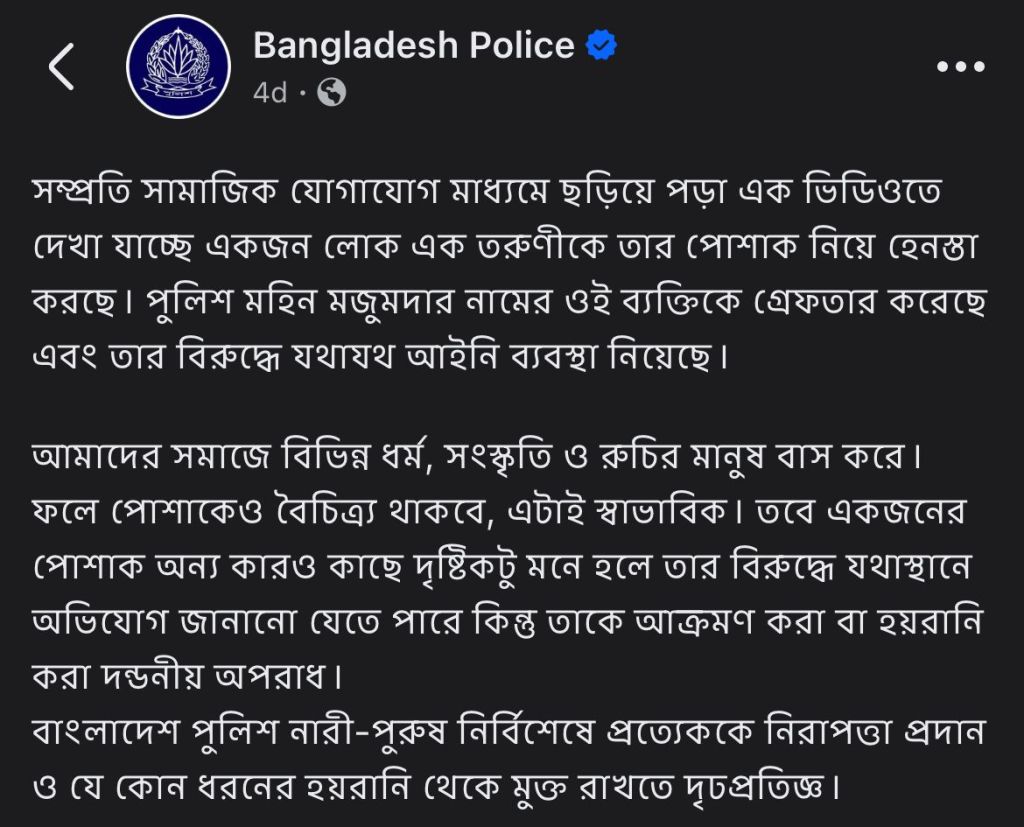
Every line you write reeks of control. You don’t talk to people; you talk down to them. You don’t protect survivors; you correct their behavior. You don’t clarify events; you clean up the state’s image. And that final line, “Bangladesh Police is determined to provide security to everyone, regardless of gender,” OH PLEASE! If words could protect us, maybe women wouldn’t need to live in fear.
The truth is, your violence doesn’t only happen on the streets; it happens in your words. Every “clarification,” every “official statement” is a way of disciplining us, of reminding people who gets to define truth. You don’t just police bodies; you police language, emotion, and dissent, and that’s why no one believes your version of justice anymore.
Tanveer Anoy is an activist, author, and currently a PhD student in Feminist Studies at the University of Minnesota. They can be reached at tanveeranoy@gmail.com.
 Bangladesh Feminist Archives