
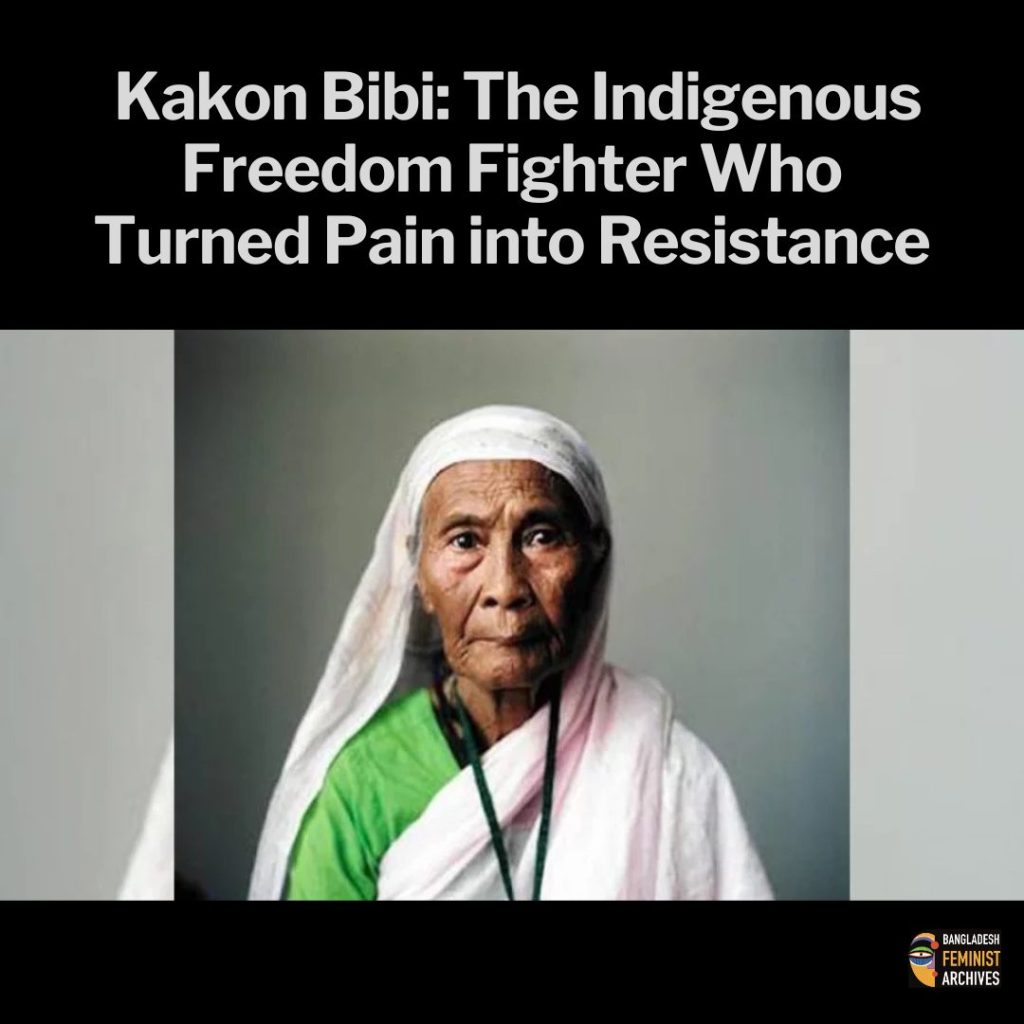
Kakon Bibi, one of Bangladesh’s most fearless Indigenous women freedom fighters, fought in nearly 20 battles during the 1971 Liberation War, serving as a scout for the Muktibahini and sustaining multiple bullet wounds. She carried those scars on her body until her death on March 21, 2018, in Sylhet MAG Osmani Medical College Hospital.
Born in the Khasi community of Meghalaya, Kakon, whose birth name was Kaket Hannyata, was orphaned as a child and raised by her sister and brother-in-law. Married at fifteen to a Pakistani soldier, she was later abandoned, then remarried a Sylheti farmer before being left to raise her daughter, Sokhina, alone.
During the war, Kakon was captured and raped by the Pakistani army in Doarabazar, escaped, and joined the Muktibahini under Lt Col Mir Shawkat Ali, who tasked her with gathering intelligence while disguised as a beggar. She infiltrated Pakistani camps to collect crucial information before being recaptured, tortured for seven days, and left for dead. Rescued by locals, she recovered and rejoined the freedom fighters, this time as an armed combatant.
Despite her extraordinary bravery, Kakon Bibi lived much of her post-war life in hardship and social erasure, both as a woman and as an Indigenous freedom fighter. Her story resurfaced in 1996 through journalist Ronendra Talukdar Pinku and the Bangladesh Nari Progati Sangha (BNPS), leading to official recognition and her Bir Protik title. Yet she continued to face bureaucratic neglect, her name briefly removed from the gazette and her stipend discontinued.
Kakon Bibi spent her final years in Jirargaon village, Sunamganj, surviving on minimal support. Her life, marked by Indigenous identity, gendered violence, and unyielding resistance, remains a testament to the countless women whose courage was written out of Bangladesh’s dominant liberation narratives.
 Bangladesh Feminist Archives