
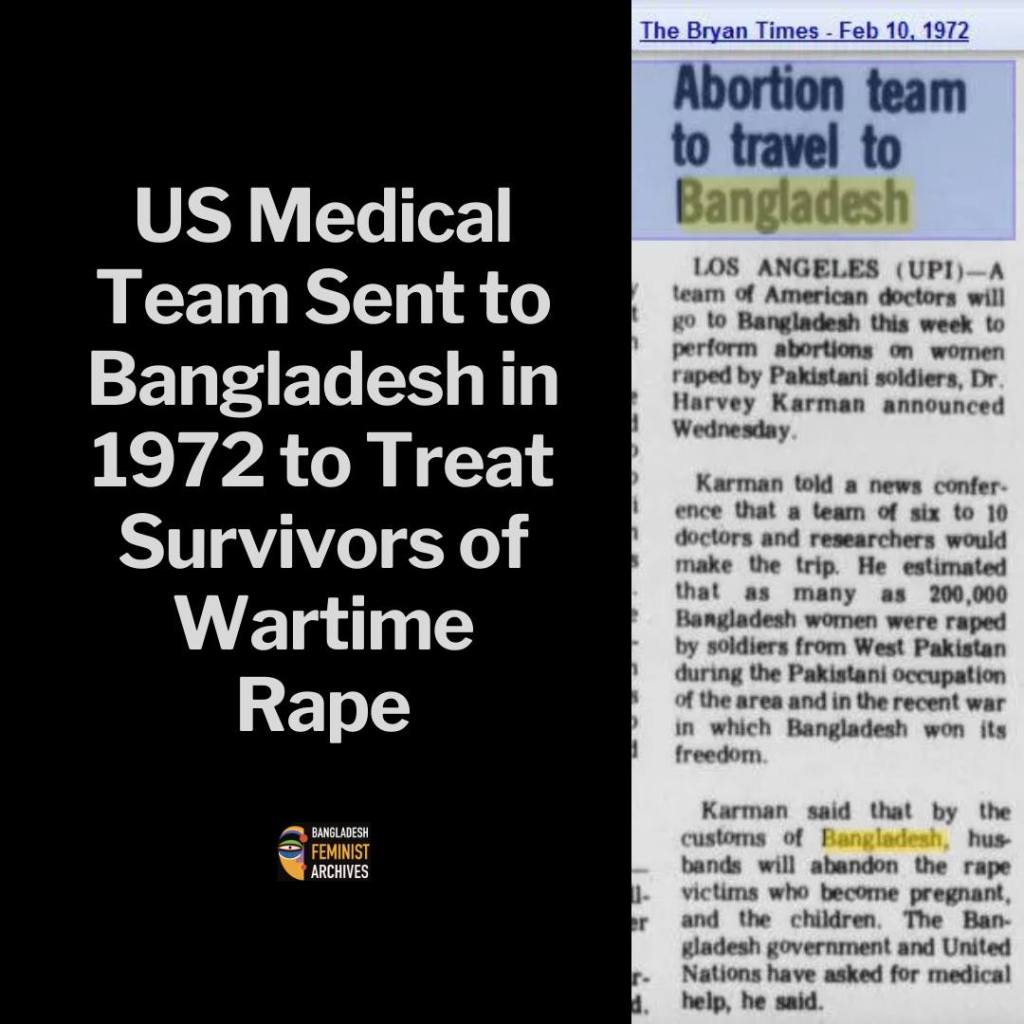
In February 1972, just weeks after Bangladesh won independence, a team of American doctors prepared to travel to the country to provide abortions for women raped by Pakistani soldiers during the Liberation War. According to The Bryan Times (Feb 10, 1972), Dr. Harvey Karman announced that six to ten physicians and researchers would go at the request of the Bangladesh government and the United Nations. He estimated that as many as 200,000 Bangladeshi women had been raped during the occupation, noting that social customs often led husbands to abandon women who became pregnant through rape, leaving survivors and newborns extremely vulnerable.
Evidence of the brutality is further documented by Dr. M. A. Hassan in The Rape of 71: The Dark Phase of History. He cites testimonies and medical records detailing widespread rape, torture, and mutilation. One account describes how Rauful Hossain Suja, searching for his father’s body at the FOY’S LAKE killing site in Chittagong, saw thousands of corpses, including 84 pregnant women whose abdomens had been slashed open. Similar patterns of violence were reported across the country.
Dr. Hassan notes that fewer than 10% of rape survivors sought care at formal abortion centers in early 1972 due to stigma and fear. Many abortions occurred quietly in local settings, leaving little documentation. Women raped after September 1971—less than three months pregnant by early 1972—largely avoided hospitals altogether, a group he estimates at around 88,200 women. He further reports that within a three-month period, 162,000 raped women and 131,000 Hindu refugee women remained unaccounted for, likely absorbed into the population without support or reporting. These figures underline not only the scale of sexual violence but also the profound silence and social erasure surrounding survivors after the war.
Source: Genocide Bangladesh Archive; The Bryan Times (UPI), February 10, 1972; Columbia University South Asia Institute archival report on the 1971 genocide.
 Bangladesh Feminist Archives