
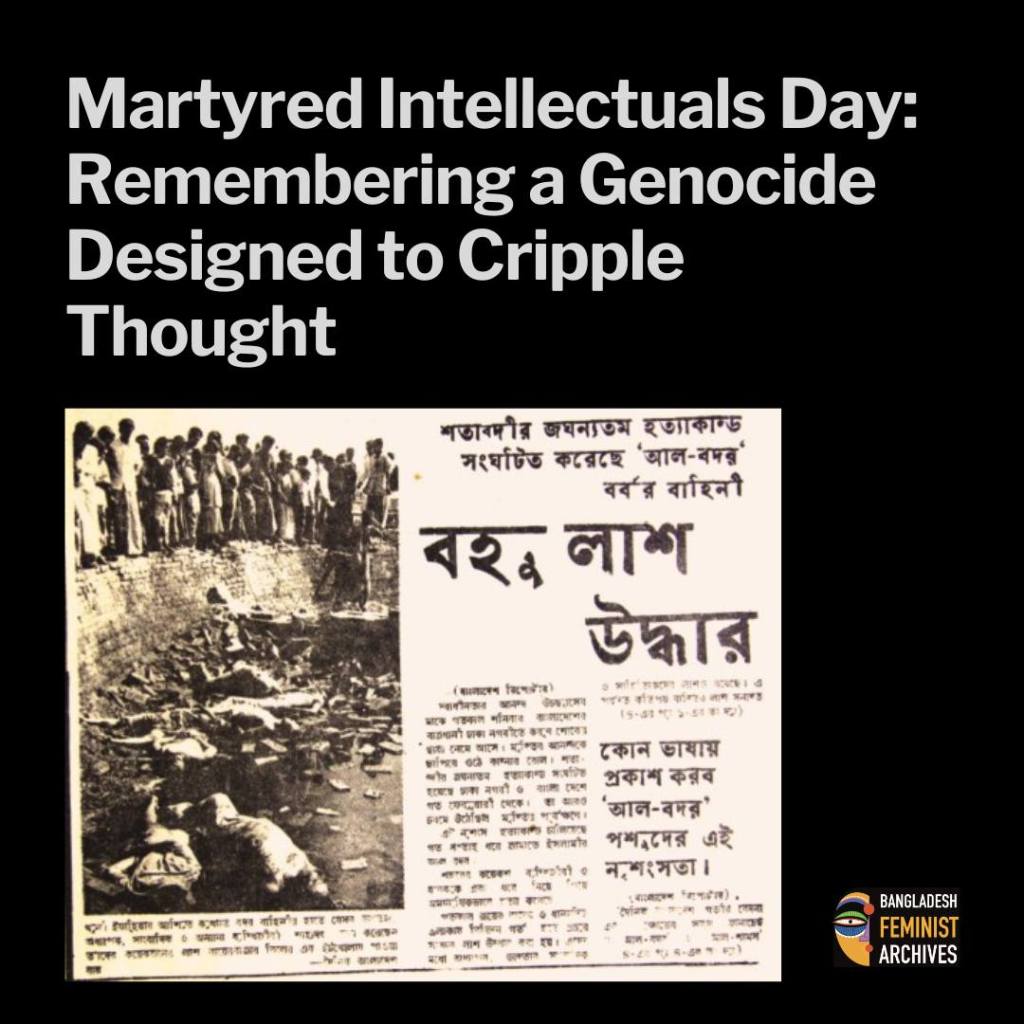
14 December is observed as Martyred Intellectuals Day in Bangladesh, marking one of the most calculated acts of violence during the 1971 Liberation War. On this day, the Pakistani military and its local collaborators, particularly Al-Badr and Al-Shams, systematically abducted and killed the country’s leading intellectuals just days before Bangladesh’s independence. The objective was not only to punish individuals, but to destroy the intellectual, cultural, and ethical foundations of a future nation.
Those targeted were not combatants. They were teachers, professors, doctors, journalists, writers, engineers, and cultural workers—people whose work shaped ideas, knowledge, dissent, and imagination. Many were taken from their homes, tortured, and executed. Their bodies were later found in mass killing sites such as Rayerbazar and Mirpur, places that remain symbols of how genocide operates through silencing thought as much as killing bodies.
Martyred Intellectuals Day reminds us that genocide is not only about mass death; it is about erasing memory, weakening resistance, and disabling a society’s ability to think critically. The attack on intellectuals in 1971 was a political strategy aimed at ensuring that even if Bangladesh became independent, it would do so without those who could question power, document truth, and imagine alternatives.
Remembering 14 December today requires more than ritual mourning. It demands reflection on how intellectuals, journalists, artists, and cultural workers continue to face intimidation, censorship, and violence in different forms. The legacy of this day asks Bangladesh to confront how easily critical voices are still treated as threats, and how silence is often normalised in the name of stability.
To mark 14 December is to insist that knowledge, dissent, and memory are not expendable. It is to recognise that the struggle the intellectuals were killed for—truth, justice, and the right to think freely, remains unfinished.
 Bangladesh Feminist Archives