
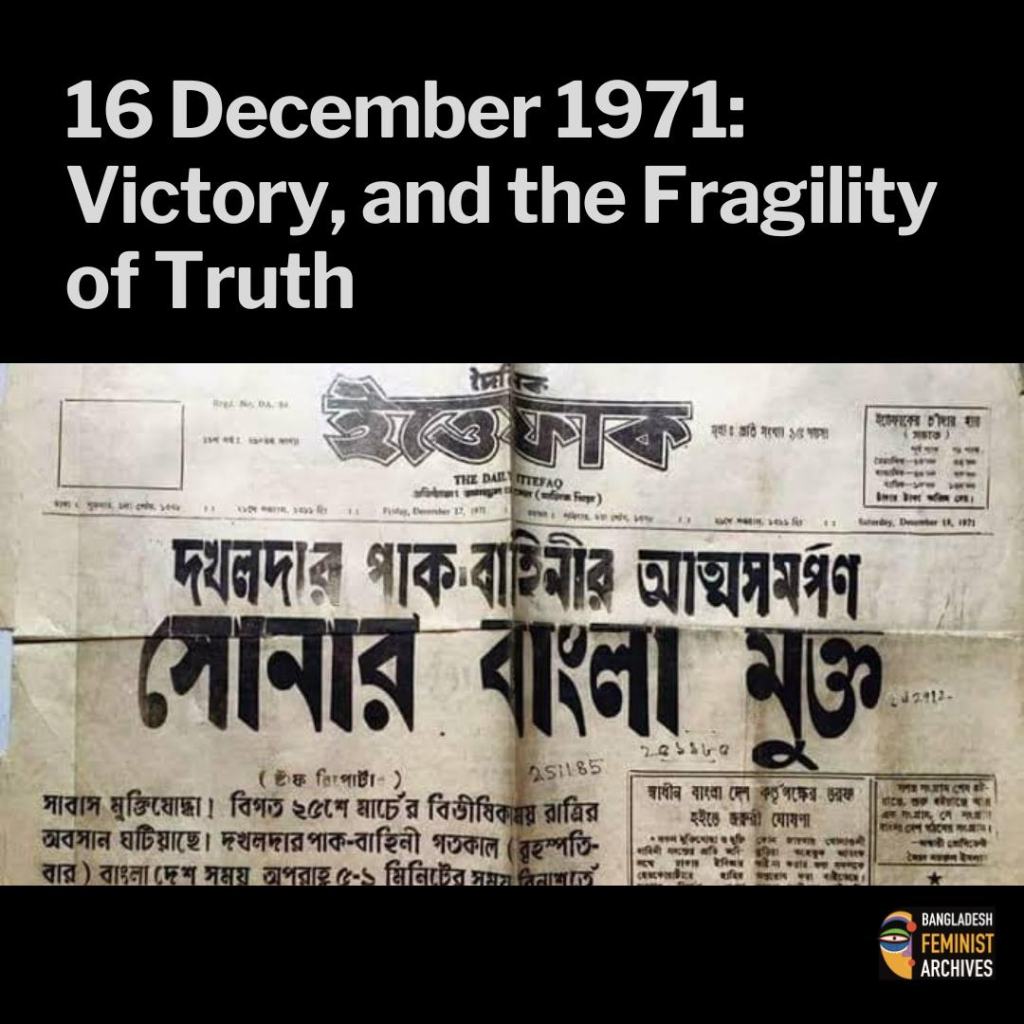
16 December is observed as Victory Day in Bangladesh, marking the formal end of the 1971 Liberation War and the surrender of the Pakistani military. Victory did not arrive gently. It arrived through blood, hunger, displacement, and unspeakable loss. Bangladesh was born not only through celebration, but through mass graves, violated bodies, burned villages, and millions forced to flee. Victory Day marks the end of occupation but it also carries the weight of everything destroyed to make freedom possible.
This victory was never simple, and it was never singular. It belonged to freedom fighters and civilians alike. To women whose suffering was silenced. To families who never recovered the bodies of their loved ones. To intellectuals murdered days before liberation. To people whose lives were permanently altered but whose names never entered textbooks. Victory was collective and incomplete.
Independence did not arrive as a clean break from violence; it emerged from it. Millions were displaced, countless lives were permanently reshaped, and entire communities were left to rebuild amid trauma and scarcity. For many, victory meant survival rather than celebration. Liberation was not only a military outcome, it was a political assertion of the right to self-determination against genocide and colonial domination.
Yet the history of 1971 is increasingly distorted and misrepresented. The war is retold selectively, stripped of its violence and political clarity. Collaborators are rebranded, crimes are blurred, and liberation is reduced to a convenient narrative. Bangladesh now stands at a crossroads where truth is treated as opinion and memory is reshaped by power. This confusion is not accidental, it is deliberate.
Victory Day is not only about remembering triumph. It is about refusing erasure. Forgetting turns genocide into debate, accountability into “division,” and justice into something optional. To honor 16 December honestly is to protect the meaning of freedom itself. Victory cannot survive without truth. A nation that loses its memory risks losing its direction, again.
 Bangladesh Feminist Archives