
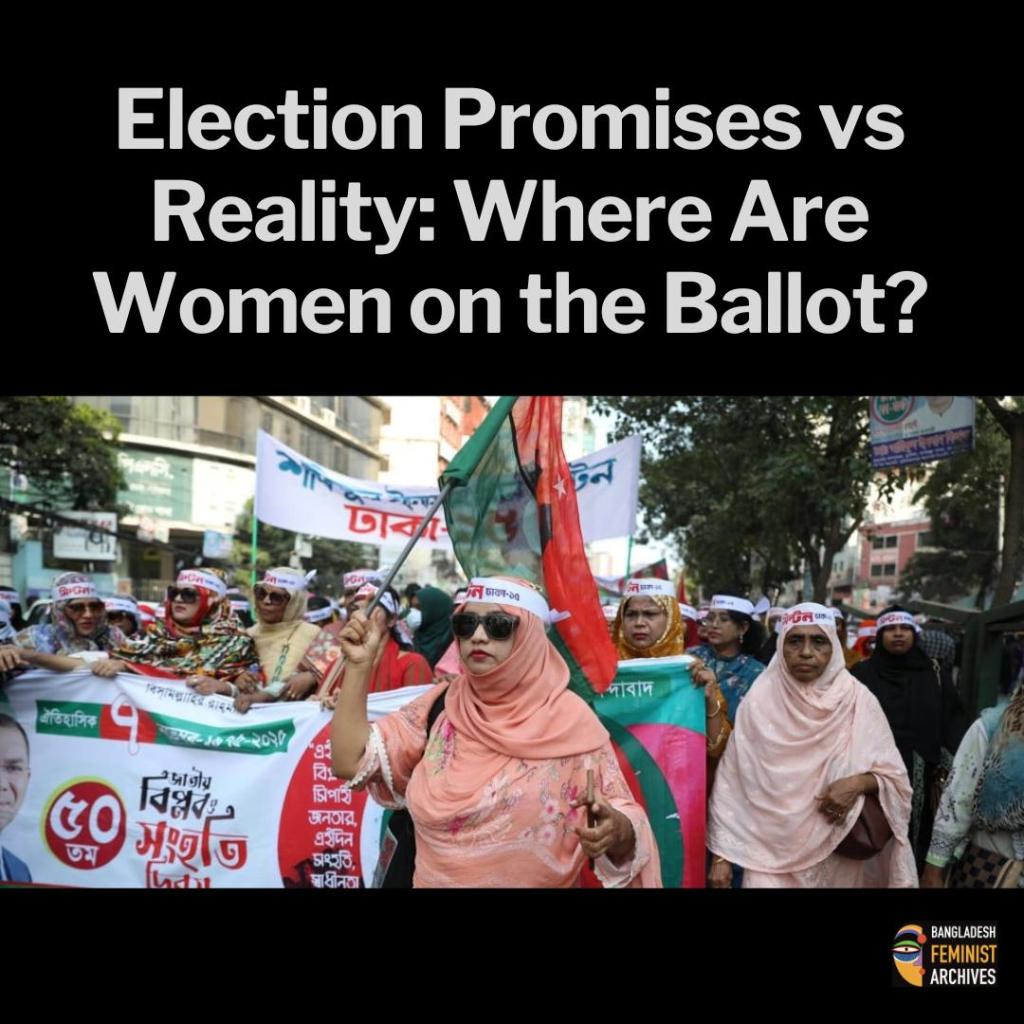
In the lead-up to Bangladesh’s 13th national parliamentary election, women remain highly visible in political mobilisation. They march, organise, chant slogans, and sustain movements. Yet this visibility has not translated into electoral representation. Candidate lists show a persistent exclusion of women from formal political power.
Earlier this year, 27 political parties pledged in the July charter to nominate at least five percent women candidates, with a long-term goal of reaching 33 percent. That commitment has largely remained symbolic. Of the 2,582 nomination papers submitted nationwide, only 110 were filed by women.
Meeting the five percent benchmark would require at least 15 women candidates across 300 constituencies. The BNP nominated 10 women, while parties aligned with the Jamaat-led alliance nominated only three women, all from the National Citizens Party. More than half of the parties contesting the election did not nominate a single woman in any constituency.
Outside the major parties, women’s participation remains scattered. Forty women are contesting as independent candidates, while smaller parties nominated women in limited numbers. Despite this, women remain overwhelmingly underrepresented in the overall candidate pool.
Party leaders explain the disparity by citing electability, local resistance, and competition with established male candidates. Critics argue these explanations reflect entrenched political attitudes rather than genuine structural barriers. Former caretaker government adviser Rasheda K. Chowdhury has noted that women continue to be viewed primarily as voters, not as candidates capable of winning elections.
This pattern is not new. Earlier commitments, including the Election Commission’s requirement to ensure 33 percent women’s leadership by 2020, were never enforced. As another election cycle approaches, the gap between rhetoric and reality remains stark.
Women’s absence from the ballot raises a central question: if parties continue to rely on women’s labour in movements while denying them space in decision-making, how meaningful are their promises of inclusion?
 Bangladesh Feminist Archives