
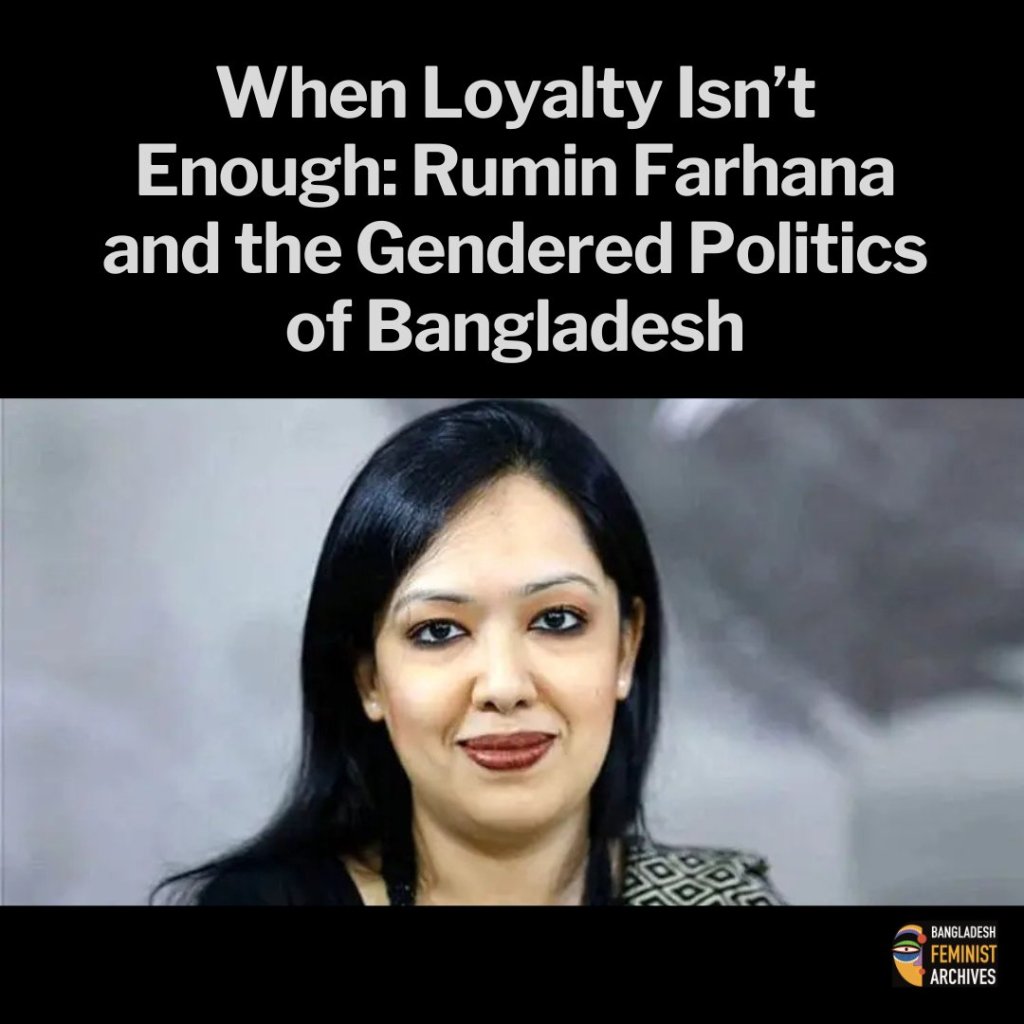
Bangladesh’s politics has never been kind to women, but Rumin Farhana’s journey makes that reality painfully clear. A lawyer, former MP, and one of the most visible faces of the Bangladesh Nationalist Party during its most difficult years, Rumin Farhana was often the one standing at the front, speaking when others stayed silent, defending the party in hostile spaces, and carrying the weight of opposition politics in a deeply male-dominated arena.
When the BNP struggled to articulate a clear, forceful public voice, it was often Rumin Farhana who showed up, on television screens, in courtrooms, and in public debates. She was not a background figure or a symbolic presence; she was doing the political labor, absorbing the backlash, and taking the risks.
And yet, when she expressed her intention to contest the upcoming election independently, the party responded not with dialogue but with expulsion. The timing was brutal and telling: she was removed from the BNP on the very day Khaleda Zia died. As the nation mourned, a woman who had long defended the party was quietly discarded.
This is the unspoken rule of Bangladeshi politics for women: loyalty is expected, autonomy is punished. Women are celebrated as symbols, but disciplined when they act as political agents. They are useful in moments of crisis, expendable when they demand space.
Rumin Farhana’s story is not just about one politician or one party. It exposes a deeper truth about Bangladesh’s political culture, where women are praised for endurance, not rewarded with power; where sacrifice is normalized, but leadership is tightly controlled.
Her expulsion does not diminish her political relevance. Instead, it reveals the system’s fear of women who refuse to remain in assigned roles. And that, more than anything, explains why Bangladeshi politics continues to fail its women.
 Bangladesh Feminist Archives