
by Tanveer Anoy
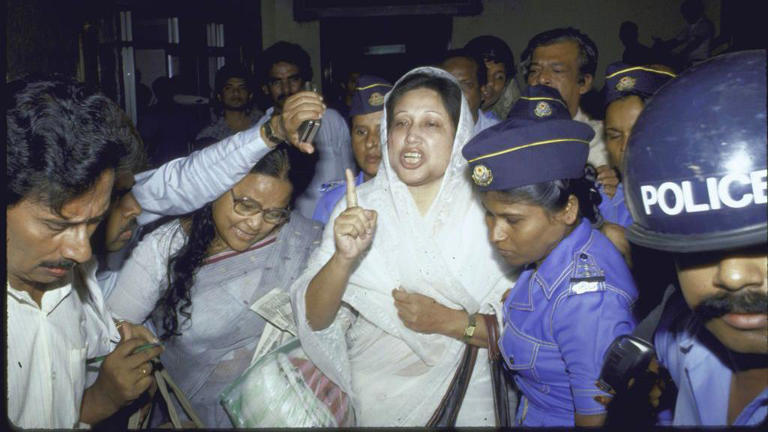
Bangladesh is mourning Khaleda Zia, the country’s first female prime minister and longtime chairperson of the Bangladesh Nationalist Party (BNP), who died after a prolonged illness. Her farewell has been immense: streets filled with vast crowds of mourners, television channels running continuous coverage, commentators reaching for superlatives, and political leaders across ideological divides issuing statements steeped in reverence. The scale of the moment is unmistakable, marking not only a death but the production of a national spectacle.
That spectacle demands attention, not because mourning itself is wrong, but because of the kind of memory it is actively producing.
Khaleda Zia was not simply a former prime minister. She was one half of a political dynasty that shaped Bangladesh for decades, and her rise to power cannot be separated from the life and rule of her husband, Ziaur Rahman, a military officer who became president during the post-independence period of instability, governed under martial law, and later sought to legitimize his authority through elections. His regime fundamentally reoriented Bangladeshi politics by elevating militarized nationalism, institutionalizing Islamization, marginalizing leftist politics, and reshaping the state away from the secular promises of the liberation movement.
Khaleda Zia did not merely inherit a party after his assassination; she inherited an ideological project. Her political career unfolded squarely within a right-wing nationalist framework forged through military power and consolidated through electoral politics, a context that is essential to understanding her rule and yet is precisely what is being erased in the current wave of remembrance.
In public memory, she is now being recast as a fearless democratic icon. The language circulating in media and political commentary is striking: “uncompromising leader,” “symbol of resistance,” “champion of democracy.” This framing suggests a moral clarity that her actual political life never possessed. Khaleda Zia was undoubtedly a consequential leader, but she was also deeply polarizing and controversial. Her governments were marked by intense political violence, entrenched patronage networks, attacks on minorities, and a shrinking space for dissent. Her alliance with Jamaat-e-Islami was neither incidental nor accidental; it was a deliberate right-wing coalition that shaped governance, street politics, and cultural power. None of this is obscure history. It is documented, lived, and easily searchable, yet in death, these realities are being smoothed away through selective remembrance.
What we are witnessing is selective amnesia unfolding in real time.
What makes this moment particularly unsettling is its contrast with recent history. For years, under the Hasina regime, large sections of Bangladesh’s media operated under fear, relying on self-censorship, silence, and strategic ambiguity. During periods marked by enforced disappearances, democratic backsliding, and repression, courage was scarce; many outlets avoided confrontation, and many commentators chose safety over accountability.
Now, with Khaleda Zia’s death, bravery has returned, but only in the form of praise. Fearlessness appears suddenly abundant when political risk has disappeared, and critique seems safest when its object can no longer respond. This shift is not accidental.
Political death often functions as absolution. Once accountability becomes impossible, complexity becomes inconvenient. Memory is cleaned up, ideology is softened, and power is rebranded as sacrifice. Mourning becomes a final stage through which legitimacy is restored, and contradictions are quietly buried.
Gender plays a crucial role in this process of laundering. Khaleda Zia’s status as the first female prime minister is repeatedly invoked as moral insulation, as though breaking a gender barrier automatically confers progressive politics. Feminist history has never worked that way. A woman can shatter ceilings while governing through conservative, exclusionary, or harmful ideologies, and feminism cannot be reduced to symbolism alone without being emptied of its analytical power.
This is why the farewell feels like a blockbuster, not merely because of its size, but because of its choreography. The crowds, the cameras, the ritualized grief, and the carefully curated language together perform a version of history that is emotionally satisfying and politically safe. Spectacle flattens; it demands reverence rather than reckoning, and refusing that flattening is not disrespect but responsibility.
People have every right to mourn Khaleda Zia. She mattered deeply to many, and she shaped the country’s political life for decades. But mourning does not require hero worship, and death does not erase ideology.
Khaleda Zia was a flawed leader, not as an insult but as a historical fact. She governed within a right-wing, militarized political tradition that carried real consequences for democracy, minorities, and dissent. Acknowledging that reality alongside grief is not cruelty; it is honesty.
Feminist memory work insists on holding contradiction: leadership alongside harm, symbolism alongside material outcomes, resistance alongside complicity. When we trade that complexity for comfort, we do not honor the dead; we deceive the living. Bangladesh does not need saints. It needs memory that refuses to forget how power was built, exercised, and justified, even when doing so disrupts the spectacle that surrounds it.
If naming that truth unsettles the moment, then perhaps that disruption is exactly what this moment requires.
Tanveer Anoy is an activist, author, archivist, and currently a PhD student in Feminist Studies at the University of Minnesota. They can be reached at tanveeranoy@gmail.com.
 Bangladesh Feminist Archives