
by Muntasir Rahman
I am Md. Muntasir Rahman, an activist. My activism primarily focuses on gender and sexual minorities; alongside this, I have long worked on women’s rights, minority rights, and broader human rights issues.
On July 15, 2024, while gathering news for a foreign newspaper, I began searching for movement coordinators and contacted them for information. On humanitarian grounds, and in an effort to protect them from violence, I became fully and actively involved from July 26 with Rifat Rashid, Abdul Hannan Masud, Mahin Sarkar, and Abdul Qader. I stood beside them until August 5.
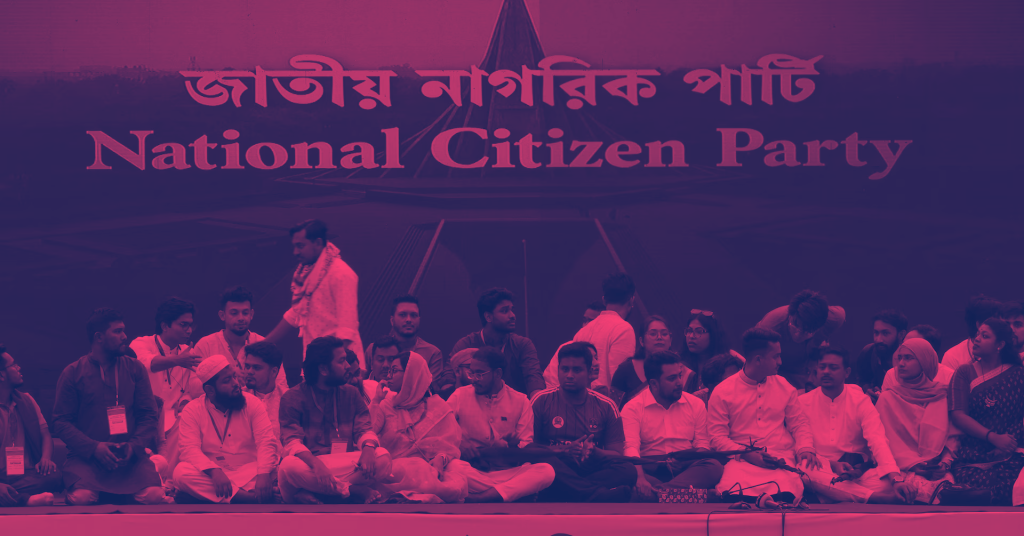
Between August 5, 2024, and February 28, 2025, after many ups and downs, the National Citizen Party (NCP) was formed and formally launched. Trusting my July comrades and placing my faith in them, I joined the party with the belief that it would introduce a new kind of politics in Bangladesh, one that would establish a new political settlement, recognize everyone as citizens, and bring all people forward as part of a new political constituency.
However, on the very first day of the party’s launch, I became the target of extremist groups and political attacks, solely because of my photograph and my LGBTQ activism. Despite being a comrade from the July uprising, I was effectively excluded from the party without any official confirmation. Not only did the party fail to stand by me publicly, but senior leaders, including Sarjis Hasnat, openly sided with the online mob that targeted me. Despite repeatedly requesting official meetings, I received no communication from the party. Even when I raised concerns about my personal safety, I received no response. Instead, I heard from multiple leaders: “It’s not possible to provide security for Muntasir within the party.”
The party’s chief, Nahid Islam, told the foreign news agency AFP regarding me:
“We believe in inclusion, but there are certain boundaries defined by religious and cultural practices.”
The same Nahid Islam who had protested against discrimination in July was unable, or unwilling, to take a stand against the discrimination I faced within his own party.
At the initial stage, I was under severe threat to my life. On February 28, 2025, when online attacks against me were at their peak, a July comrade and NCP leader called me and said, “We may be temporarily removing you; perhaps we’ll bring you back later.” At the time, I assumed they were struggling to manage the situation themselves and that they would eventually contact me again. I was not mentally in a state to think clearly. It took me nearly three months to fully understand that the party would never contact me officially again. The party did not even consider it necessary to show basic communication, courtesy, or respect. No official explanation was ever given to me.
At one point, I had deep hopes for the party. Over time, however, those hopes steadily faded as I observed its increasing politics of appeasing hardliners. The formation of committees to police children’s and women’s clothing, renewed public anti-LGBTQ statements by Sarjis Alam, the absence of strong responses to attacks on Indigenous communities in front of education boards, and the failure to investigate allegations of harassment and misconduct against party leaders, allowing them to continue their political roles, have all compounded this disillusionment.
Further disappointment came from the continuous targeting and labeling of former comrades and left-leaning thinkers, the NCP’s silence during violent attacks, Hasnat Abdullah speaking at Hefazat gatherings where members of the Women’s Commission were referred to as “prostitutes,” and standing alongside Ashraf Mahadi while echoing extremist rhetoric at Baitul Mukarram. Witnessing these events nearly extinguished any remaining hope for a genuinely new politics.
Even setting ideology aside, the inclusive political culture we had imagined was never practiced internally. Various wings and committees were formed only to be left inactive. Policy decisions remained concentrated in the hands of a small group of influential leaders, and a culture of consultation never developed.
The condition of many grassroots leaders was particularly distressing. They sacrificed time, employment, and personal security for the party, yet many were forced to leave quietly due to neglect and humiliation. They, too, had believed the party would practice politics for everyone and uphold civic dignity. In reality, influential figures gradually sidelined even their own comrades.
In July, we were promised the end of discrimination, the triumph of merit, and the abolition of unjust quotas to ensure opportunity based on competence. Yet after July, even our own student leaders failed to dismantle this system. Instead, many became absorbed into the same corrupt structures of recruitment rackets, extortion, bribery, and lobbying.
Today, little functions in the country without bribes, influence networks, or mob pressure; this has become the prevailing reality.
Under the watch of NCP leaders, mob politics has become deeply entrenched. They have actively accommodated and legitimized political and religious mobs. As a result, the period following July has seen the consolidation of mob rule rather than the establishment of the rule of law. Senior NCP leaders have shared platforms with religious extremists who openly propagate fascist hatred. For the failure to establish the rule of law after July, the NCP bears significant responsibility.
At the time, many so-called well-wishers associated with the genocidal Awami League claimed, “They are Jamaat–Shibir; they are Islamist hardliners.” We consistently defended the NCP. Yet, on the eve of elections, the National Citizens’ Party has driven the final nail into the coffin of the promise of new politics and a new settlement.
Initially, the party announced a new “third force” alliance, only to later betray its partners and form an alliance with Jamaat-e-Islami, the party associated with the 1971 genocide and Al-Badr, alongside other hardline Islamist right-wing groups. This came despite Nahid Islam stating only days earlier, in late October, that the party would not contest elections alongside parties with histories of genocide. Subsequently, an NCP leader publicly acknowledged that the alliance with the Jamaat had been carefully planned.
Those of us who joined in the hope of building new politics have been directly deceived. Many important leaders have already left the party, from central executive positions to grassroots organizers. Those who leave are subjected to severe online harassment by NCP leaders, reflecting a complete absence of political civility or ethical conduct.
The NCP had claimed it would contest all 300 seats and proposed forming an upper house through peer-based reforms. The current reality, however, is starkly different. In alliance with Jamaat, the party initially announced it would contest 47 seats in the lower house, then reduced this to 30, and now reports suggest the number may be as low as 10. The NCP is no longer contesting for an upper house at all.
This alliance was structured in such a way that leaders who left the party cannot even stand as independent candidates. The intention was clear: to prevent any dissident NCP candidate from contesting seats allocated to Jamaat. In this way, the leadership has attempted to control the electoral landscape until voting day.
Today, senior NCP leaders dream of electoral victory through Jamaat’s vote bank—a scenario that is highly unrealistic. Yet their personal political survival matters more to them than the party or its founding ideals. The question remains: how could they betray the spirit of July, achieved through so much bloodshed, sacrifice, and loss?
As one comrade said, “Bhai, we have nowhere left to go. We can’t go to the BNP, and we can’t align ourselves with this Jamaat alliance either.”
Those of us who waited for nearly a year and a half in the hope of new politics have been utterly deceived.
A small group of NCP leaders now appears to believe that Jamaat will provide protection to a handful of them after the election. They no longer maintain contact with other party leaders, often refusing even to answer phone calls.
Today, we stand before a vast darkness. I feel a deep sense of revulsion even speaking about the NCP. I have never experienced regret like this in my life.
We have been deceived. We have been deceived. We have been deceived.
 Bangladesh Feminist Archives