
by BDFA Team
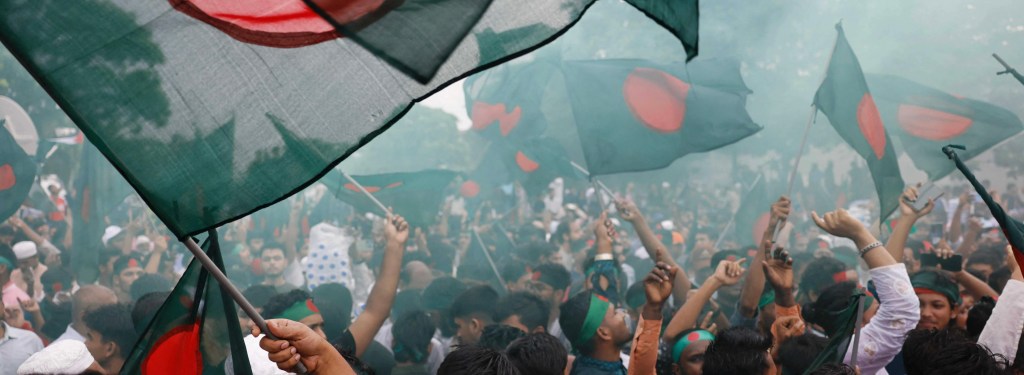
Bangladesh goes to the polls on 12 February 2026 for the 13th parliamentary election, held alongside a national referendum on constitutional, electoral, and institutional reforms emerging from the July National Charter process. This vote is being marketed as a “reset” after the upheavals that followed the July 2024 uprising, a rupture sparked by the job-quota controversy and escalated by a violent crackdown that shattered the claim of “normal” democratic rotation. The promise was a new political contract: accountability, repaired institutions, and protection for those routinely sacrificed to “stability.”
But a reset is not declared; it is demonstrated. It is measured in whose lives become safer, whose rights become enforceable, and whose political futures become imaginable. By those standards, this election reveals more continuity than transformation.
That is why we, the Bangladesh Feminist Archives, endorse no candidate and no political party in this election.
Let’s start where parties most loudly claim legitimacy: inclusion. The numbers collapse the performance. Only 4.24% of candidates are women, and even the minimal pledge that emerged from the Charter discussions has been disregarded. BNP’s nominees include only 3.5% women. Jamaat-e-Islami is fielding no women candidates at all. Alliance negotiations have pushed women out, AB Party dropped all three women candidates it had nominated; NCP reduced women nominees after seat-sharing. This is not a pipeline problem. It is the political class saying, through its nominations, that women’s power is optional.
Now consider the election’s atmosphere: insecurity is not incidental; it is baked into the terrain. Political violence and vigilantism are rising beyond routine partisan clashes. Religious minorities face escalating fear, with more than 2,000 incidents of violence targeting minorities and at least 61 killings recorded since the political rupture of 2024, alongside persistent patterns of impunity. In this landscape, parties campaign on “law and order” while marginalized communities calculate survival.
Indigenous communities, particularly in the Chittagong Hill Tracts, experience this political continuity in even sharper form. Their lives remain shaped by militarization, land dispossession, settler expansion, and decades of unimplemented political agreements. For Adivasi peoples, elections rarely signal protection; they signal the persistence of a state that negotiates their existence without securing their rights. Reform discourse rings hollow where Indigenous land remains contested, and Indigenous communities continue to live under securitized governance rather than meaningful political autonomy.
This is where every major contender fails the intersectional test, in different ways, yet with the same outcome.
The BNP presents itself as the inevitable alternative, confident enough to reject unity arrangements while projecting dominance. But dominance is not a feminist program. Its women’s nominations fall below even the Charter’s minimal commitments, and its posture has centered on majoritarian victory rather than on binding, measurable guarantees of gender justice, minority protection, and labor rights. If the party cannot meet a basic nomination benchmark when the whole country is watching, why believe it will deliver deeper structural change once it controls the state?
The Jamaat-led alliance has re-entered mainstream contestation while benefiting from an atmosphere of polarization and minority fear, yet it is contesting hundreds of seats without a single woman candidate. Whatever language of “values” it offers, its nominations communicate a political order where women’s leadership is unnecessary. That is not tradition; it is institutionalized exclusion.
The Gen Z–driven NCP and the broader “new politics” ecosystem are often framed as rupture. Youth energy may be decisive in this election, but novelty is not accountability. Women candidates were dropped during seat-sharing negotiations, and internal bargaining treated women’s political presence as negotiable. A politics that cannot protect women’s candidacies inside its own alliances cannot credibly promise protection for women’s lives outside parliament.
And yes, the failure is not only partisan. The interim government, tasked with creating conditions for a credible democratic reset, has also failed the intersectional test. Minority protection remains fragile, impunity persists, and political violence, mob attacks, and repression continue. Civic space remains constrained, with ongoing concerns about protest crackdowns, pressure on media and cultural spaces, and the use of sweeping security laws. A “reset” that cannot secure civic freedoms is not a reset; it is a managed handover.
Even the July National Charter, held up as the emblem of reform, cannot be treated as proof of transformation. It is politically contested, its enforcement mechanisms remain unclear, and parties have violated its commitments almost immediately, starting with the 5% women nomination pledge. Reform language without redistribution of power becomes political branding.
An intersectional feminist test is not complicated: Who expands protection? Who makes rights enforceable? Who redistributes power toward those most exposed to violence and disposability? On those questions, the parties competing in this election offer variations of the same political architecture: patriarchy in nominations, impunity in violence, bargaining that treats marginalized lives as negotiable, and a governing imagination that still mistakes “stability” for justice.
Supporters will say incrementalism is better than instability. Bangladesh has heard that argument for decades. It is the language through which justice is postponed, women’s safety deferred, minority protection made contingent, workers disciplined in the name of growth, and queer and trans lives kept in administrative precarity.
Bangladesh deserves more than electoral choreography. It deserves a politics where women’s leadership is non-negotiable, minority safety is guaranteed rather than managed, labor dignity is structural rather than rhetorical, and civic space is protected rather than policed.
Until protection, accountability, and equality become the foundation of power, not its afterthought, we endorse no one. This election may change who governs, it does not yet change who is protected.
 Bangladesh Feminist Archives