
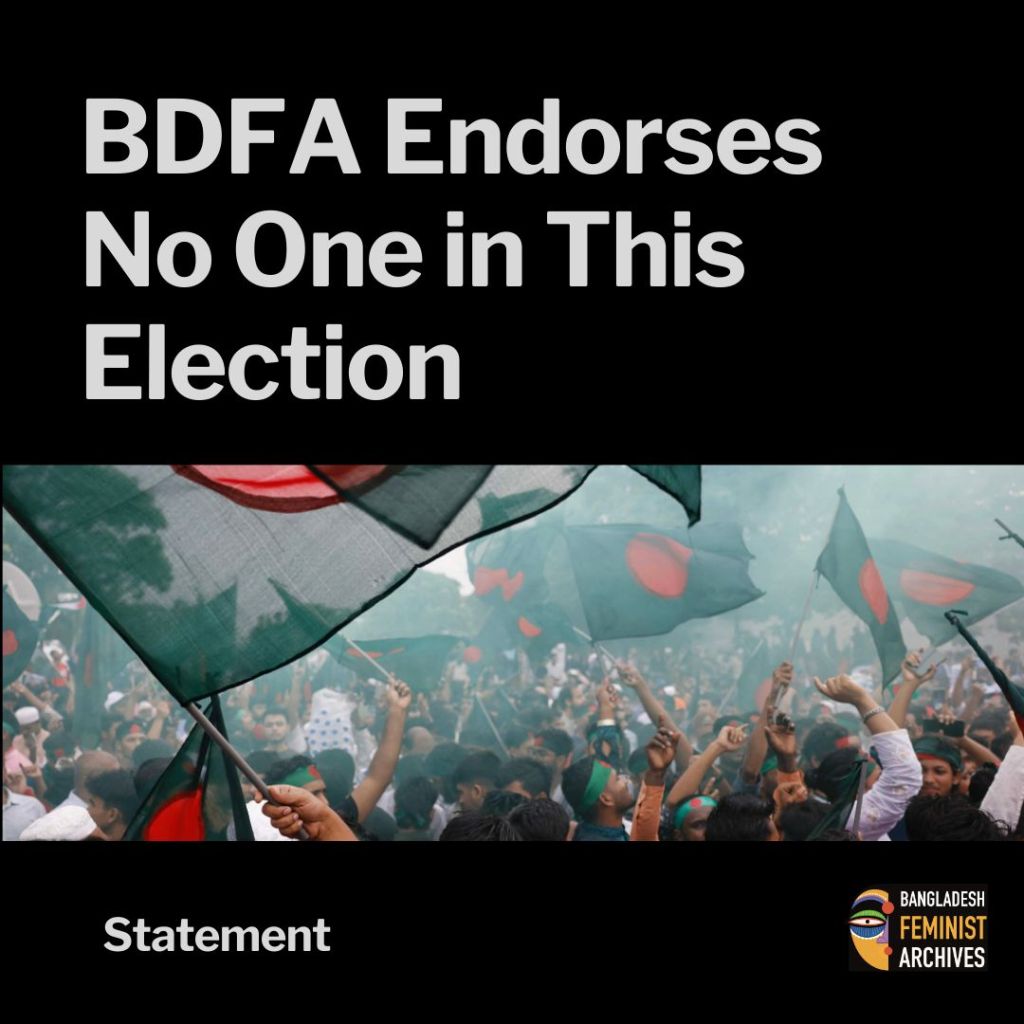
Bangladesh goes to the polls on 12 February 2026 for the 13th parliamentary election, framed as a “reset” after the July 2024 uprising and interim transition. But a reset is not declared; it is demonstrated in whose lives become safer, whose rights become enforceable, and whose futures become imaginable. By those standards, this election shows more continuity than transformation.
That is why the Bangladesh Feminist Archives endorses no candidate and no political party.
Only 4.24% of candidates are women. BNP’s nominees include 3.5% women. Jamaat fields none. Women candidates were dropped in alliance negotiations. This is not oversight; it is design.
Political violence and vigilantism are rising. Religious minorities face fear, with over 2,000 incidents of violence and dozens of killings since 2024, amid persistent impunity. Parties speak of “law and order” while marginalized communities calculate survival.
Indigenous communities in the Chittagong Hill Tracts continue to live under militarization, land dispossession, and unimplemented agreements. Elections rarely signal protection; they signal continuity.
Women face a reality where 76% have experienced intimate partner violence. Workers remain vulnerable in a growth-first model. Queer and trans lives remain precarious. Civic space remains constrained.
The interim government did not dismantle these structures, and parties contesting this election operate within them. Reform language without redistribution of power becomes branding.
An intersectional test is simple: Who expands protection? Who makes rights enforceable? Who redistributes power toward those most exposed to violence and dispossession?
This election may change who governs. It does not yet change who is protected.
Read our full statement: https://bdfeministarchives.org/…/bdfa-endorses-no-one…/
 Bangladesh Feminist Archives