
by Hana Shams Ahmed
The Bangladesh elections have concluded, and the initial wave of euphoria among the younger generation–many of whom had never been able to vote because of the blatantly undemocratic conduct of the previous elections–has given way to a sobering awareness of what this electoral outcome means for us. The elections of 2014, 2018, and 2024 were regarded as deeply flawed exercises that hollowed out democratic credibility. The Awami League’s determination to remain in power at any cost, coupled with Sheikh Hasina’s personal vendetta against political rivals, ultimately rebounded against her. The very insistence on control that sustained her rule for years eventually cornered her, leaving her with no option but to leave Bangladesh secretly, an outcome that stood in ironic contrast to her earlier public declarations, made in the third person: “Sheikh Hasina palay na! [Sheikh Hasina does not run away!]”
The country is now led by Tarique Rahman, a figure with a chequered political history, but whose experience of torture while in military custody in 2008, and exile for almost two decades by the subsequent League government, has created a redemption narrative in the popular imagination. His mother, former Prime Minister Khaleda Zia, endured prolonged persecution under Hasina’s administration and passed away only two months before her son’s pyrrhic electoral victory.
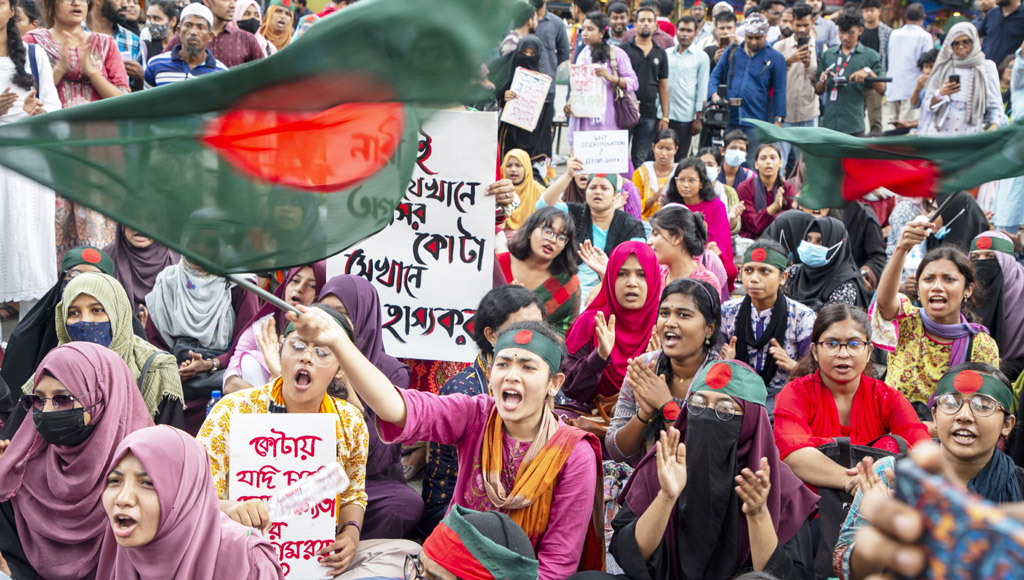
These personal and political histories are intertwined with the broader cycles of retribution that have defined Bangladesh’s political trajectory. The decade-long crackdown on opposition activists, especially members of the BNP, under Hasina’s increasingly authoritarian rule, was compounded by mounting corruption scandals and the erosion of institutions. That path was never going to be sustainable in the long term. Political reckoning, in one form or another, was inevitable. The 2018 movement against quota reform, the 2018 road safety protests, and the increasingly authoritarian state responses to student mobilizations were all manifestations of deep public frustration. They reflected widespread anger at the narrowing space for political participation and the shrinking possibilities for meaningful reform.
It was genuinely heartening to hear that Bangladesh managed to conduct what appears to have been a largely peaceful election. There were certainly isolated incidents, and allegations surfaced from multiple sides, including claims of fraud both by and against Jamaat. But, according to friends and colleagues who took part in the voting process, the atmosphere remained comparatively calm, with significantly fewer violent outbreaks than many had feared. In a country accustomed to pre- and post-election turbulence, that relative calm was a welcome relief for everyone.
However, some disturbing anecdotal reports circulated that some Awami League supporters attempted to pressure Hindu voters into casting ballots for Jamaat-e-Islami. Given Sheikh Hasina’s close relationship with Narendra Modi and the broader regional political alignments, such strategic maneuvering is hardly unimaginable. A Jamaat government would have conveniently served certain reactionary narratives across the border. Public figures like Pinaki Bhattacharjee campaigned vigorously in favour of Jamaat, clearly hoping to shift Bangladesh toward a more hardline ideological direction. Despite incendiary rhetoric and mobilizations that escalated into attacks on media offices, these efforts ultimately failed to install the Jamaat in power.
Many people cast their ballots for the BNP as a defensive move to prevent Jamaat from coming to power. That reasoning is understandable, as any religion-based political party risks undermining the pluralistic desires of part of the polity. Of course, the irony of BNP’s earlier coalition with Jamaat is certainly not lost on us. This time, however, it was a vote for politics not grounded in religious extremism, misogyny, or a legacy of massacres. We can see what the BJP has done to its own Muslim minority through its Hindutva supremacy politics. Although the Awami League repeatedly weaponized the Liberation War narrative to shield itself from scrutiny over corruption and repression, that did not translate into public amnesia about Jamaat’s historical role in 1971, including their involvement in the formation of Rajakar death squads. In recent weeks, statements made by certain Jamaat leaders regarding women were outlandish, provoking visceral reactions. After decades of sustained feminist struggle and 35 years of women serving as prime ministers of the country, Jamaat leaders claimed they could not identify anywomen in their party suitable for parliamentary representation, even while deploying women to campaign for them door to door. The statement by the Jamaat leader that women could not become the top leader of the party because of their biology was unashamedly misogynistic and out of touch with a female labour structure, garments industry-driven economy.
Their rhetoric was disturbing, but unsurprising, given their history. What proved even more disillusioning was the National Citizens Party’s (NCP) decision to enter into a coalition with Jamaat. Formed after the 2024 July Revolution, NCP mobilized students under banners of anti-discrimination, anti-corruption and the rule of law–for them to align with a party whose leaders espoused openly exclusionary and misogynistic positions was dishonest and self-serving. It was especially disappointing and somewhat eye-opening to see female candidates associated with NCP get on board the Jamaat boat. Especially so for figures such as Dilshana Parul, who had long articulated feminist commitments in public forums and through organizations like Women Chapter, and her own blog Bilkis has a Point of View, where discussions of state violence, class politics within feminism, and gender equity were central themes. Watching her campaign for votes that required overlooking Jamaat’s overt misogyny, especially after reading her writing about feminist politics, was jarring.
Since the July Uprising, it has become increasingly evident that certain student leaders, particularly those who transitioned into leadership of NCP, had, in fact, long maintained close ties to Jamaat networks. This proximity also explained why several prominent women activists gradually disappeared from visible political space after July. Many NCP women leaders publicly expressed anger over the party’s compromise with the Jamaat. Two resigned outright, and Tasnim Jara, who has been so active and vocal throughout and beyond the July Uprising, decided to run as an independent candidate rather than remain under the party banner. Others withdrew from the election or declared themselves inactive. In the end, it was the women who stuck to their principles of non-discrimination that was the driving force behind the July Uprising, while many of the men chose proximity to power over the principles they proclaimed not to long ago.
What remains now is Tarique Rahman, along with the complicated and troubling legacy of the BNP itself. Many voters appear to have voted against Jamaat rather than for the BNP. The party’s own historical record cannot be so casually erased. During its previous tenure, especially their 2001-2006 rule, attacks on Hindu communities escalated, torture and intimidation of journalists, including cases of enforced disappearance, especially through the Rapid Action Battalion (RAB)–the elite law enforcement agency originally formed in 2004. We strongly criticize the AL for using RAB for enforced disappearances, however it was the BNP which founded this ‘death squad’, as it has been called by the Human Rights Watch.
For the people of the Chittagong Hill Tracts, the BNP is a mordantly significant name. It was under the BNP that the founder, President Ziaur Rahman, began the Bengali settlement process under military supervision, reshaping the region’s demographic composition, and the military was institutionalized in ways that continue to shape the region’s political landscape. It was this military involvement that continues to fuel violence in the area to this day. In 1997, it was the BNP that organized a Long March opposing the signing of the CHT Accord, branding it a black Accord and accusing the accord negotiators of ‘selling’ the Chittagong Hill Tracts to India.
During 2001-06, when BNP and Jamaat governed together, their thugs were widely accused of terrorizing journalists, beating reporters into silence, filing dozens of cases against media outlets, and maintaining an atmosphere in which witnesses were too afraid to testify in murder trials. Along with many cases of corruption, multiple murders and explosive cases were attributed to their local leaders. In the national scene, allegations against Tarique Rahman himself include the case of the ten-truck arms haul, the 2004 grenade attack on Sheikh Hasina that killed twenty-four people and injured hundreds. The general absence of meaningful accountability during BNP governance remains a troubling history that people need to know.
The Awami League maintained power for so long largely because of its authoritarian consolidation and sustained harassment of BNP leaders and activists. The BNP’s current victory is, in part, a consequence of the Awami League’s inability to participate in this election. Jamaat’s substantial vote share also shaped the outcome. Meanwhile, ordinary citizens continue to live with the cycles of retaliatory politics that do not lead to any substantive democratic gain for Bangladesh’s political structure. We oscillate between rival authoritarian tendencies, living in insecurity, polarization, violence, impunity, corruption and the steady erosion of civic and intellectual life. Instead of investing in institutional resilience or democratic culture, we find ourselves perpetually mobilizing against one autocrat after another.
Preventing Jamaat from capturing state power demanded immense collective mobilization. That achievement is meaningful. A Jamaat-led administration would likely have decimated gains in women’s rights, been just as corrupt as any other party, and their rewriting of history to erase their complicity with murder and rape of Bengalis in 1971 would have created an even more oppressive society and political culture. In that limited sense, simply averting that outcome feels like survival.
But survival is not transformation.
The July Uprising had widespread participation from women and gender-diverse people. Courageous, thoughtful, and politically sharp non-male participants were not merely present but central to organizing networks, mobilizing crowds, shaping strategy, and sustaining the energy and direction of the protests. Nevertheless, in the aftermath, many were sidelined, particularly within male-dominated student political formations. The persistent underrepresentation of women and gender-diverse people in leadership positions remains glaring. BNP has had a woman leader for the longest time, but this new BNP very much looks like a manel; there is just a single woman minister and two women state ministers in the entire 50-member cabinet. In the new parliament, it will be men who make all the decisions, even the ones about women, given that a man has been given responsibility for the women’s ministry. The military continues to treat the Hill Tracts as a cantonment, and the role of state minister of CHT given to a Bengali, along with previous appointments during the interim government, also made it very clear who is really pulling the political strings in the country.
The election in Bangladesh may have drawn a line under one political chapter, but it has not addressed the structural deficiencies that produced this crisis.
Hana Shams Ahmed is a former journalist and coordinator of the International Chittagong Hill Tracts Commission and is currently a PhD Candidate at York University in Toronto, Canada.
 Bangladesh Feminist Archives