
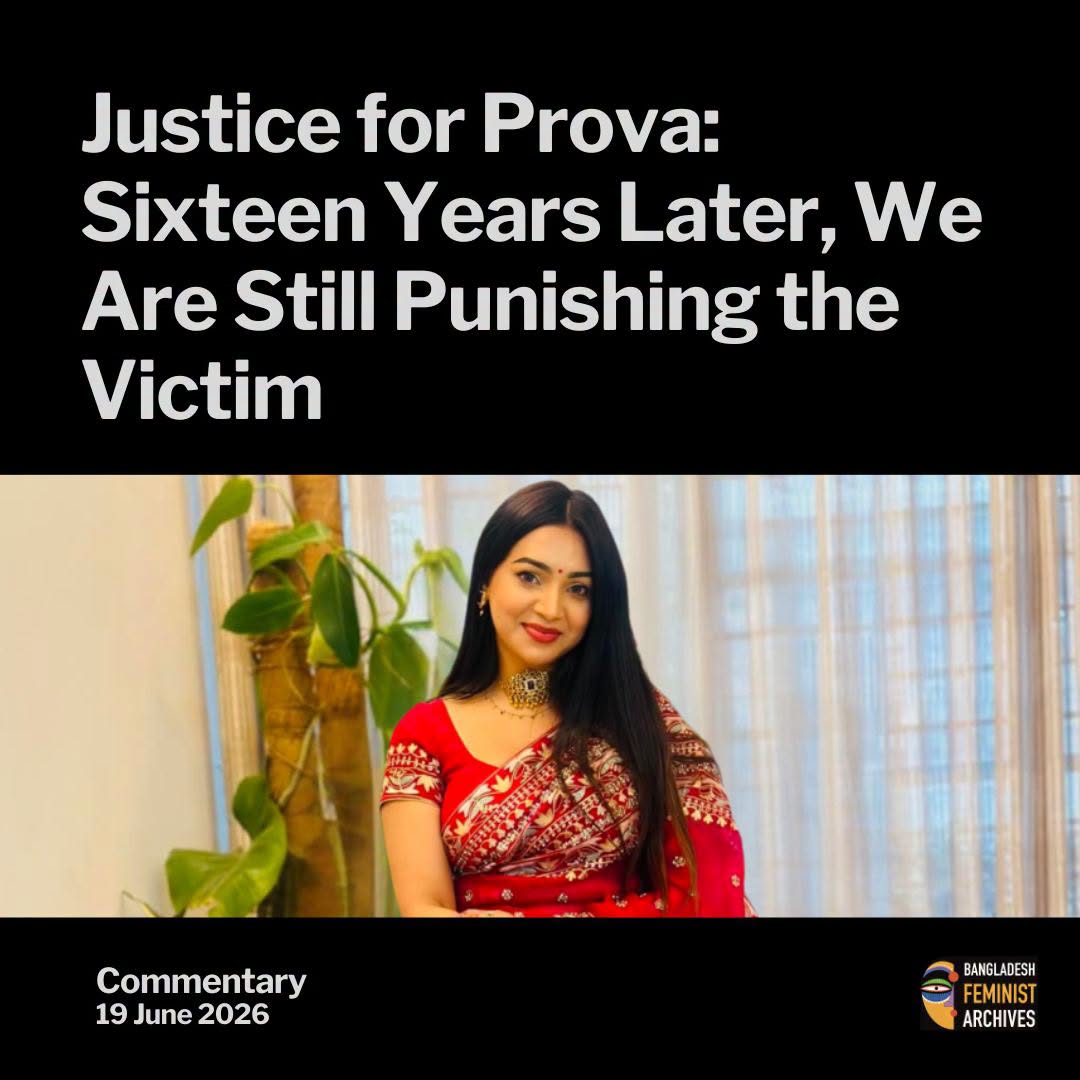
Sixteen years ago, the non-consensual circulation of intimate content involving Sadia Jahan Prova became one of the most widely discussed media events in Bangladesh. Sixteen years later, she is still being asked to carry its consequences.
Listening to Prova’s recent video, what stands out is not anger, but exhaustion. The exhaustion of having to repeatedly witness a society choose spectacle over accountability. A society that remembered the woman at the center of the violation but largely forgot the violation itself.
For years, Prova’s name has functioned as a punchline, a cautionary tale, a source of gossip, and an object of public fascination. Generations of internet users have encountered her not through her work, but through an incident in which her privacy was violated. The fact that this remains true sixteen years later should concern all of us.
What happened to Prova did not occur in a vacuum. It emerged from a culture deeply invested in regulating women’s bodies, sexuality, and respectability. The public conversation was never primarily about consent. It was about a woman. Her choices. Her relationships. Her morality. Her worth.
Meanwhile, the actual harm, the violation of privacy and trust, became secondary.
The language of cyberbullying, digital consent, and image-based sexual abuse has become more common in Bangladesh over the past decade, but Prova’s experience reveals how little has changed. We continue to live in a culture where survivors are expected to absorb the consequences of violence long after public attention has moved on.
Prova asks why so much energy was spent ridiculing her instead of confronting those responsible. It is a question worth sitting with. Because it exposes a broader truth: victim-blaming is not a side effect of violence. It is one of the ways violence is sustained.
Sixteen years is a long time to be punished for being harmed.
Justice for Sadia Jahan Prova requires more than sympathy. It requires acknowledging that what happened to her was never entertainment, never gossip, and never a public morality play. It was a violation. And the burden of that violation should never have been hers to carry.