
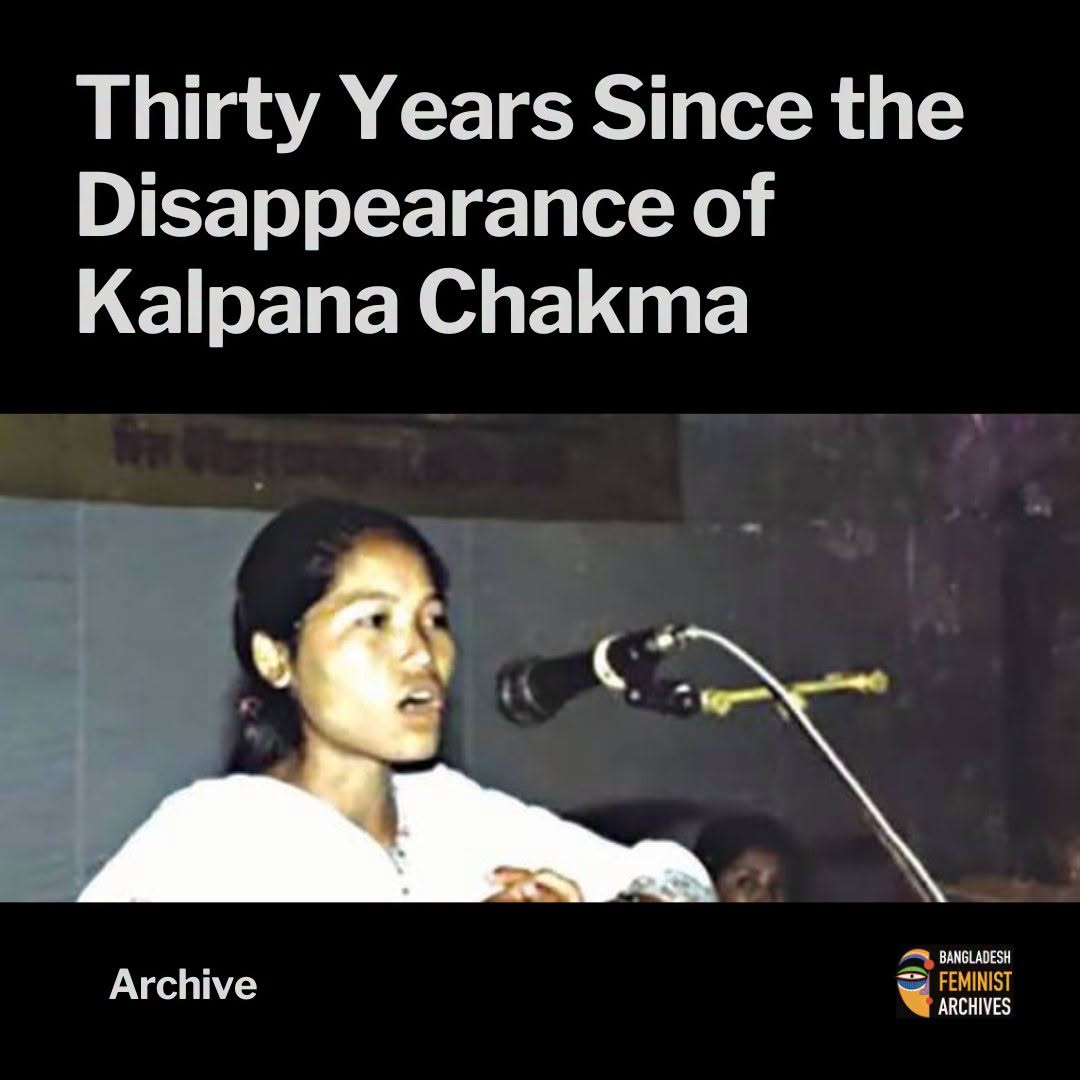
On 12 June 2026, thirty years passed since the disappearance of Kalpana Chakma, an Indigenous rights activist and Organizing Secretary of the Hill Women’s Federation.
Kalpana Chakma was abducted from her home in Lallyaghona village, Baghaichhari, Rangamati, in the early hours of 12 June 1996. According to eyewitness accounts, armed men in military uniform entered the house and took her away. Despite decades of demands from her family, Indigenous organizations, and human rights activists, her whereabouts remain unknown.
Born in 1973, Kalpana Chakma was a student activist and organizer who worked on issues affecting Indigenous peoples in the Chittagong Hill Tracts (CHT), particularly Indigenous women’s rights. Her disappearance quickly became one of the most prominent unresolved cases in the history of the region and a symbol of the broader struggles faced by Indigenous communities in the CHT.
Over the past three decades, Kalpana’s family and Indigenous rights organizations have repeatedly sought justice and accountability. Multiple investigations were conducted, yet no one has been held responsible for her disappearance. In April 2024, the Senior Judicial Magistrate Court in Rangamati dismissed the case, a decision that was met with criticism from Indigenous organizations and human rights advocates. A revision petition seeking reinvestigation was later filed.
The thirtieth anniversary was marked by commemorations across the Chittagong Hill Tracts. The Hill Women’s Federation organized a human chain in Rangamati demanding justice for Kalpana Chakma, a renewed investigation into her disappearance, and implementation of the CHT Peace Accord. Speakers connected her case to ongoing concerns regarding Indigenous rights, militarization, land dispossession, and violence against Indigenous women.
Thirty years after her disappearance, Kalpana Chakma remains a powerful figure in Indigenous political memory. Her name continues to be invoked in demands for truth, accountability, and justice, while her disappearance remains one of the longest unresolved human rights cases in Bangladesh.