
Written by Muntasir Rahman
This account has been documented and published with Rihiya Rihi’s consent.
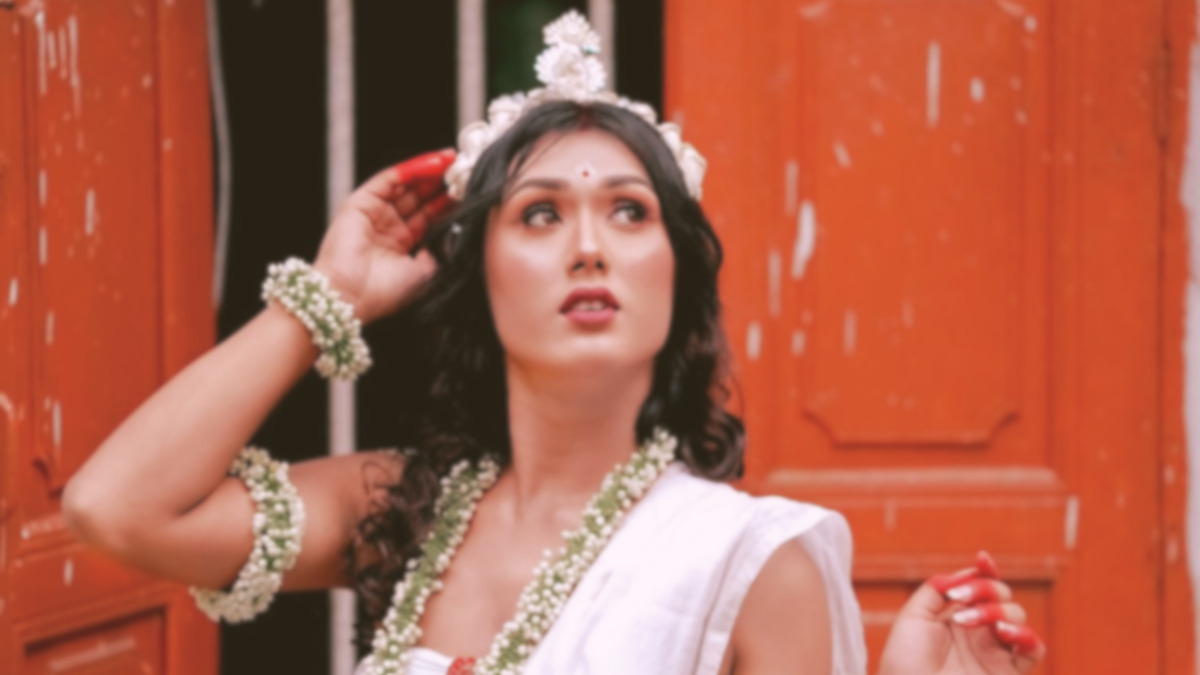
Rihiya Rihi is a trans woman from Sayedabad village in Kosba Upazila, Brahmanbaria. She was assigned male at birth and has not undergone medical transition, though she had been receiving facial laser treatment. She is currently a second-year Bachelor of Social Science (BSS) student at Sayedabad Government College and comes from a farmer family.
Rihi has been involved in dance since childhood and has worked professionally as a dancer since 2019. She trained at the upazila level under Sabikunnahar Saba Nritya Monjuri. Alongside dance, she has also worked in modeling and brand promotion, including parlor bridal shoots, and has appeared in three music videos.
Her family still sees her as a boy. They became aware of her identity after her SSC exams, when she began making videos and presenting herself in feminine ways. At first, her family did not support her, though she continued living with them. Over time, their attitude shifted somewhat. They have become relatively more accepting, especially because she earns through her professional work. Even so, when people in the village make negative comments about her, the family often reacts harshly.
Among her friends, however, Rihi was viewed positively. She was selected as the Cultural Secretary of the student body at Sayedabad Government College, a position considered important and visible. Those involved in giving her the post, particularly members of JCD, knew her as someone from the same locality and were known to have a relatively open-minded attitude. Through her talent in dance, Rihi had already achieved first place at the college, upazila, and district levels. In cultural work, there was no one considered more qualified than her, which is why she was chosen for the role.
At the same time, her friends and peers did not know that she identified as transgender. They knew that she performed professionally while presenting herself in feminine ways, but they did not know about her gender identity, and they did not object to her TikTok activities either.
The attacks began after she was given the student body position. Her photo was uploaded to Facebook by political opponents, and soon after, posts started circulating from several Islamic and Jamaat-affiliated accounts. These posts questioned why a transgender person had been given such a role. Yet there was no video or statement in which Rihi herself publicly said she was transgender. That narrative spread through rumor, seemingly circulated by people from her own village.
The first post appeared on Saturday, the 4th, around midday, after news of her appointment became known. By the afternoon, multiple Facebook accounts were posting that Rihi was transgender, and the claims quickly went viral. The posts declared that a transgender person could not be allowed to live in the area, be part of society, or remain in Kosba. Many of the comments came from unknown individuals online.
Initially, villagers did not react strongly. But once pages associated with Jamaat-linked local groups began sharing the issue and framing it as a religious matter, the attacks intensified. After that, local people in the village also began to join in. By Sunday, the situation had escalated sharply. Rihi was threatened with death if she returned home, and early that morning she was forced to leave the village.
On Saturday night, anticipating danger, Rihi packed her belongings and prepared to leave. By Sunday morning, she had taken shelter at a friend’s house. During this time, her paternal uncle, another uncle, and two cousins came to her home. When they found that she was not there, they opened her luggage, took out her women’s clothes, and burned them outside the house.
At that time, only her father was at home. He is described as a simple and non-confrontational person. Later, when her mother returned and saw what had happened, she questioned why such destruction had taken place. These relatives live separately, but they came to the house intending to subject Rihi to a kind of “community judgment,” question her, and even force her to cut her hair.
After the incident, Rihi was removed from her position as Cultural Secretary. It remains unclear whether this decision is temporary or permanent. Although the college is still open, she has been unable to attend classes because of fear for her life. Her second-year final exams are scheduled for April 20. Even though she has completed registration, she does not believe she will be able to sit for them. She fears that if she is seen, she may be killed. She had earned a second division in her first year and had been preparing seriously for these exams.
On April 5 2026, a joint complaint was submitted to the Upazila Nirbahi Officer (UNO) in Brahmanbaria. The complaint was filed by several individuals from the upazila who identified themselves as members of “Towhidi Jonota,” conscious citizens, and student groups, including Hasan Mahmud, Aminul, and Ariful.
According to the complaint, two individuals, Rihiya Rihi and Rinku Sarkar Robin, had allegedly been engaging in activities while presenting themselves as women, which the complainants described as inappropriate and objectionable. The complaint claimed that these actions were disrupting the local environment and public order. It further alleged that they were sharing explicit and objectionable content on social media, which, according to the complainants, was negatively influencing adolescents, youth, and the broader public. Based on these claims, they called for legal action under applicable laws.
A press conference concerning transgender individuals and the wider community was also held on April 5. In an event published by Voice of Kasba, a representative of “Towhidi Jonota,” who identified himself as a journalist named Reza, made remarks targeting Rihi. He claimed that certain showroom owners and businesses were using her to promote products in ways that allegedly violated religious and social values. He also criticized JCD for appointing her as Cultural Secretary without what he described as proper background verification.
During the press conference, additional statements were made that portrayed transgender identity negatively. It was also stated that a letter had been sent to the Brahmanbaria JCD regarding the matter. Those speaking said that complaints had been submitted to both the Officer-in-Charge (OC) and the Upazila Nirbahi Officer (UNO) of Kosba, framing the situation as a major social concern and demanding action.
At the same press conference, Hasan Mahmud, one of the complainants, made several openly hostile remarks about transgender people. He said that around 100 transgender individuals, including Rihi, should be made to sign written undertakings and face punishment under the law. He also said transgender people should publicly ask for forgiveness and called on the administration to ensure that they would not be able to speak out again.
He thanked the Brahmanbaria District JCD for temporarily removing Rihi from the Cultural Secretary position and demanded that this removal be made permanent. He further stated that if transgender people “cannot be normal,” then in his view they should not be allowed to take part in politics or become members of parliament. He added that they would oppose transgender people having political rights in the Kosba area.
Other allegations were also raised during the press conference, including claims that a transgender woman named Rabil had threatened IUB teacher Sorowar Hossain and Manarat University teacher Asif Mahtab, and that an MP had supported Rabil. The speakers called for public punishment in that matter as well. They also claimed that organizations funding transgender communities should face punitive action.
Instead of receiving protection, Rihi was contacted by the UNO and the police and was reportedly advised to publicly clarify her gender by identifying as male, since she had not undergone medical transition. She was told that if she presented herself as a “boy,” the situation might be resolved.
Meanwhile, no visible action was taken against those who had threatened to expel or kill her.
Several journalists, including from Prothom Alo, reached out to her. In response, Rihi said that she had been working professionally in video content for six to seven years and could not simply abandon her livelihood. She also explained that she was being forced to identify as male under pressure, despite knowing who she is.
Only four friends, all of whom are also trans women, initially reached out to support her. No organizations contacted her in the beginning, though some modeling agencies did. She was not previously involved in activism or community organizing.
Her family, too, came under threat. They became unable to leave the house freely, and warnings were issued that if Rihi could not be found, her father would be expelled from the home.
Despite the seriousness of the crisis, the local Member of Parliament from Brahmanbaria-4, Mushfiqur Rahman, remained silent and took no visible steps to ensure her safety.
No community-based organizations or human rights groups had contacted her until later, except for outreach from Muntasir Triaana of Byanjona Foundation.
On April 10, Rihi and Ripon were called to the police station. Before being taken there, Rihi was forced to cut her hair. At the station, they were made to sign a written statement declaring that they would not identify as transgender and would not appear as women on social media. Both were forced to identify themselves as men. They were not given any copy of the statement. A video of the incident was later circulated publicly.
After returning home, Rihi was again pressured to change her Facebook name. On April 12, her Facebook account was disabled.
Rihi now says that she wants to leave the country. She fears that the pressure on her life may push her toward suicide. She has lost her ability to work, her online platform, and even her hair, each of which was deeply tied to her identity and livelihood.
Despite the presence of numerous women’s organizations, community groups, and human rights organizations in Bangladesh, she has not received meaningful support. Instead, some activists have questioned why she identified herself as male under pressure. But that question cannot be answered honestly without asking whether anyone can truly understand such a decision without standing where she stood.
The case of Rihiya Rihi exposes a disturbing pattern of institutional failure, social prejudice, and political opportunism that has left a transgender individual in extreme vulnerability.
What is especially alarming is the role of political student leadership, particularly the Jatiyatabadi Chhatra Dal (JCD), which appears to have acted under pressure rather than principle. Instead of upholding fairness and inclusion in an educational space, the decision around Rihi’s position was quickly reversed in response to outside agitation. This reflects a broader willingness to sacrifice an individual under ideological and social pressure.
Equally troubling is the conduct of law enforcement and administrative authorities. Rather than protecting a citizen facing threats, the police and the UNO reportedly advised Rihi to change how she expressed and identified herself in order to “resolve” the situation. This shifts responsibility away from the perpetrators and onto the victim, effectively legitimizing coercion and reinforcing systemic discrimination.
The response of the local administration also raises serious questions about due process and protection under the law. Those issuing threats appear to have faced no accountability, while the person under attack was subjected to surveillance, forced statements, and restrictions on her identity and expression.
Civil society and community-based organizations also failed to respond in a timely and meaningful way. The lack of early intervention from human rights groups and women’s rights organizations reveals a painful gap between institutional presence and actual responsiveness on the ground. When support did come, it was delayed and far too limited compared to the scale of the crisis.
This is not simply an isolated incident. The treatment of Rihi reveals how social prejudice, political pressure, administrative complicity, and civil society silence can converge to isolate and endanger a gender-diverse person. Unless accountability mechanisms are strengthened and rights-based protections are applied in practice, these patterns will continue, and individuals like Rihi will keep bearing the full cost of systemic failure.
Muntasir Rahman is an LGBTQI+ activist from Bangladesh, working on advocacy, inclusion, and social justice. He is the Chairperson of Byanjona Foundation.